I had set myself a challenge. I was going to write a 12-song series...and I had only written Song #1.
Song #2 wasn't going well. I found myself feeling self-critical and increasingly blocked, while I was trying to write something that celebrated a prolific and generous writer (which is to say, the person I feared I wasn't).
The breakthrough came when I acknowledged to myself that I was, indeed, stuck.
I wasn't writing anything good. I felt like a failure, a fraud, completely unlike all the artists I planned to use as inspiration for my series.
Admitting that to myself turned out to be the key to the song.
When the darkness overtakes me, and I can't drift back to sleep...when the right words still escape me and my dreams have dimmed too deep ...
Well, maybe these lyrics weren't as brilliant as Bruce Cockburn's, but at least these lyrics were true I thought, as I tossed out all my horrible faux-enlightened verses.
As I kept writing ( When there's nothing I can write now that I see how much is wrong...When I can't seem to recall how to turn sorrow back to song) I realized that it's that characteristic in particular--the ability to keep working and writing even in the face of sorrow and injustice--that I most admire in Bruce Cockburn.
It's not just his finger-picking style or his detailed lyrics or even the fact that his songs are politically and socially motivated. It's the fact that he's seen so much horror in the world first-hand (far more than I probably ever will) yet still finds the energy, courage and inspiration to make new songs.
He's gone deliberately into dark places in himself and in the world...and come out, well, singing. That, to me, is the heart of his songs and the reason they've inspired me for so many years.
It's when I can't move forward that he (and people like him) come to mind: people who find ways to make meaning and even joy in the midst of fear.
It's when I feel the most down that I need these artists the most: I need their songs, and their example.
"You Come to Me", April 4th, 2006
Monday, April 17, 2006


Saturday, April 15, 2006
On Wardrobe
Tonight I'm playing a benefit show for CFMU, a radio station in Hamilton, Ontario. A bunch of good performers are on the bill, including Toronto's Gregg Lawless and Steve Briggs, plus Stephen Fearing, an inspiring guitarist and songwriter I've looked up to for quite a while.
As usual, I spent quite a bit of time deciding what to wear.
Recently I saw a young woman perform for the very first time in a tiny Japanese restaurant. She wore an evening gown and very high shoes. At one point I thought she was going to fall face-first into the sushi.
She made the mistake of wearing something to the gig that she'd never wear in real life. The outfit contributed to her nervousness.
When you try too hard with your wardrobe, you're asking for disaster. But on the other hand, if you wear something that you'd just as likely wear to No Frills, you probably will feel as if you don't belong on the stage, under all those lights and stuff. That's how I feel anyway.
Gig apparel must be that ever-challenging perfect combination of elements. Special...yet comfortable. Fancy...but not fussy. And then there are other considerations, especially if you're a woman.
Sexy? (My husband is always encouraging me to go this route...and I appreciate the compliment.) Yes, why not...as long as I feel comfortable on stage and not too self-conscious. Sometimes, too, even folksingers can have embarrassing "wardrobe malfunctions" a la Janet Jackson's Superbowl escapade. I saw one woman perform in a gorgeous silk top that just happened to keep half-falling off. I felt bad for her at first, but then I started to suspect that she was intentionally letting it fall. And then I was just annoyed.
Pretty/tough? Youthful/mature? Trendy/classic? These choices, faced by everyone who wears anything, are more important when people are going to be staring at you for any length of time.
How do TV anchor people do it? Well, I guess the really successful ones have professional stylists...and a wardrobe budget.
Me, I go to Value Village.
That's where I went today, and found a form-fitting but not low-cut t-shirt with design that says "Schmidt's Cafe" in just the right amount of sequin action. (That's another thing: glitter is good, but if there's too much of it, you just look like a bad lounge singer.)
Magically, the top goes with my best pair of slightly shimmery magenta jeans...which I have now worn to at least five gigs. Total cost of outfit: $18.00.
I'll post a picture later.
--
By the way, I did write that Bruce Cockburn song and it turned out great. I was just keeping you (and myself too for awhile) in suspense. In my next post I'll tell you how I survived that particular patch of writer's quicksand.
As usual, I spent quite a bit of time deciding what to wear.
Recently I saw a young woman perform for the very first time in a tiny Japanese restaurant. She wore an evening gown and very high shoes. At one point I thought she was going to fall face-first into the sushi.
She made the mistake of wearing something to the gig that she'd never wear in real life. The outfit contributed to her nervousness.
When you try too hard with your wardrobe, you're asking for disaster. But on the other hand, if you wear something that you'd just as likely wear to No Frills, you probably will feel as if you don't belong on the stage, under all those lights and stuff. That's how I feel anyway.
Gig apparel must be that ever-challenging perfect combination of elements. Special...yet comfortable. Fancy...but not fussy. And then there are other considerations, especially if you're a woman.
Sexy? (My husband is always encouraging me to go this route...and I appreciate the compliment.) Yes, why not...as long as I feel comfortable on stage and not too self-conscious. Sometimes, too, even folksingers can have embarrassing "wardrobe malfunctions" a la Janet Jackson's Superbowl escapade. I saw one woman perform in a gorgeous silk top that just happened to keep half-falling off. I felt bad for her at first, but then I started to suspect that she was intentionally letting it fall. And then I was just annoyed.
Pretty/tough? Youthful/mature? Trendy/classic? These choices, faced by everyone who wears anything, are more important when people are going to be staring at you for any length of time.
How do TV anchor people do it? Well, I guess the really successful ones have professional stylists...and a wardrobe budget.
Me, I go to Value Village.
That's where I went today, and found a form-fitting but not low-cut t-shirt with design that says "Schmidt's Cafe" in just the right amount of sequin action. (That's another thing: glitter is good, but if there's too much of it, you just look like a bad lounge singer.)
Magically, the top goes with my best pair of slightly shimmery magenta jeans...which I have now worn to at least five gigs. Total cost of outfit: $18.00.
I'll post a picture later.
--
By the way, I did write that Bruce Cockburn song and it turned out great. I was just keeping you (and myself too for awhile) in suspense. In my next post I'll tell you how I survived that particular patch of writer's quicksand.
Saturday, April 08, 2006
Brooooce
Encouraged by the positive response to "We Come From the Same Place" (my Neil Young tribute song), I started to write the second song in the series. To make life easier for myself, I picked a subject I knew well: Bruce Cockburn.
Ever since I started writing songs, Bruce Cockburn has been an important songwriting influence and something of a symbolic figure for me. He's appeared in dreams from time to time and has coincidentally turned up at important points in my musical life. (When I received my first major review, a larger one for him was on the same page; when I played my first folk festival, he was the headliner.)
While I wanted to genuinely pay tribute to him in a song, I also hoped that perhaps he might someday hear it, so I started in on the writing process with high expectations, ego-driven ambition, and the constant feeling that he was looking over my shoulder editing my work.
This made this writing process rather difficult.
For instance, as soon as I noticed angel/critic Broooce whispering in my ear, I had to be sure that I didn't take his suggestions too much to heart. I didn't want this song to become an "imitation Bruce Cockburn" song. Nor did I want it to be a song written FOR him by me.
It appeared that this song would be up against some challenges from the start (not unlike other second-borns, I suppose). Not to worry, I told myself. I can do this. As if to prove it to myself, I quickly found a guitar figure that was suitably Brucey (yet simple enough for me to actually play) and composed a pretty melody to go with it.
Right away I started hearing him singing the melody, and suddenly I found myself fending off lyrics from his existing songs which neatly fit into my new one. I was suddenly aware of how familiar I am with Bruce Cockburn's catalogue and realized this is both a blessing and a curse when it comes to this project. I worried about unconscious plagiarism.
And then I wrote pages and pages and pages of very bad lyrics.
At least they were original.
(to be continued...)
----
Meanwhile, last week, I saw Kurt Swinghammer perform a song he had written in tribute to Burt Bacharach and Hal David.
Ever since I started writing songs, Bruce Cockburn has been an important songwriting influence and something of a symbolic figure for me. He's appeared in dreams from time to time and has coincidentally turned up at important points in my musical life. (When I received my first major review, a larger one for him was on the same page; when I played my first folk festival, he was the headliner.)
While I wanted to genuinely pay tribute to him in a song, I also hoped that perhaps he might someday hear it, so I started in on the writing process with high expectations, ego-driven ambition, and the constant feeling that he was looking over my shoulder editing my work.
This made this writing process rather difficult.
For instance, as soon as I noticed angel/critic Broooce whispering in my ear, I had to be sure that I didn't take his suggestions too much to heart. I didn't want this song to become an "imitation Bruce Cockburn" song. Nor did I want it to be a song written FOR him by me.
It appeared that this song would be up against some challenges from the start (not unlike other second-borns, I suppose). Not to worry, I told myself. I can do this. As if to prove it to myself, I quickly found a guitar figure that was suitably Brucey (yet simple enough for me to actually play) and composed a pretty melody to go with it.
Right away I started hearing him singing the melody, and suddenly I found myself fending off lyrics from his existing songs which neatly fit into my new one. I was suddenly aware of how familiar I am with Bruce Cockburn's catalogue and realized this is both a blessing and a curse when it comes to this project. I worried about unconscious plagiarism.
And then I wrote pages and pages and pages of very bad lyrics.
At least they were original.
(to be continued...)
----
Meanwhile, last week, I saw Kurt Swinghammer perform a song he had written in tribute to Burt Bacharach and Hal David.
Tuesday, April 04, 2006
The Tribute Project
It all started with Neil Young.
We went to see the movie "Heart of Gold" and bought "Prairie Wind", the CD that goes along with it. Meanwhile, I read a long interview with Neil Young in Performing Songwriter magazine, in which he describes his writing process and his life as a songwriter.
It occurred to me that even though he's in his 60s and a man and a big name, our lives as artists are very similar. This idea became the start of a song called "We Come From the Same Place" which also refers to our shared hometown of Winnipeg, Manitoba.
I wrote the song, on purpose, in a Neil Young-ish style (I could even add a little musical reference to the song "Heart of Gold" at the end if I liked). I used slightly altered basic chords, straightforward song structure, a singalong melody, strumming. The song turned out well. I was excited about writing it and eager to sing it. (It elbowed several other songs I was working on off to the side for the time being.)
And then, in the middle of finishing the song, I had an "ahah!" idea.
I could write a whole series of songs inspired by songwriters...the ones who inspired me.
This idea really turned me on. First, I like writing "on assignment". It narrows my focus immediately and gives me a bunch of ideas right away. (When I write songs solely out of my own inspiration, I try to establish the frame quickly too.) Second, I liked the idea of using songwriters themselves as subject matter--as inspiring, in their own way, as rocks and trees.
I also liked the fact that the assignment would be difficult. Would I be able to write songs that stood on their own and were not cheap imitations of the Inspiring Artist's? Could I reflect on their effect on me without being maudlin? Could I write songs that would resonate with people who are not themselves artists? Did I have enough ability, myself, to refer to such a range of styles...and to write songs that I would want to sing, apart from the project? Could I keep my own voice, while paying tribute to the voices of others?
Sure, why not! I plunged ahead.
I quickly made a list of Canadian songwriters. (Not only did I want to narrow the field--we now eliminate The Beatles, Bob Dylan, James Taylor--I also had the vague and optimistic idea that I might be able to attract government funding.) I limited it to songwriters who, I feel, have genuinely influenced my own work.
Here's the list I came up with (in no particular order).
Neil Young (might as well put him first)
Bruce Cockburn
Joni Mitchell
Jane Siberry
Ron Sexsmith
Shirley Eikhard
Leonard Cohen
Alanis Morrissette
Fred Eaglesmith
Gordon Lightfoot
kd lang
There are a few "dark horses" too...not officially on the list but still in the running. They'd be Jann Arden, Burton Cummings &/or Randy Bachman, The Barenaked Ladies, Sylvia Tyson, Raffi. (And there's the possibility that I've left somebody out...if you think of anyone, let me know.)
So, that's it. The project is underway. Two songs have been written so far!
I'll keep you posted.
We went to see the movie "Heart of Gold" and bought "Prairie Wind", the CD that goes along with it. Meanwhile, I read a long interview with Neil Young in Performing Songwriter magazine, in which he describes his writing process and his life as a songwriter.
It occurred to me that even though he's in his 60s and a man and a big name, our lives as artists are very similar. This idea became the start of a song called "We Come From the Same Place" which also refers to our shared hometown of Winnipeg, Manitoba.
I wrote the song, on purpose, in a Neil Young-ish style (I could even add a little musical reference to the song "Heart of Gold" at the end if I liked). I used slightly altered basic chords, straightforward song structure, a singalong melody, strumming. The song turned out well. I was excited about writing it and eager to sing it. (It elbowed several other songs I was working on off to the side for the time being.)
And then, in the middle of finishing the song, I had an "ahah!" idea.
I could write a whole series of songs inspired by songwriters...the ones who inspired me.
This idea really turned me on. First, I like writing "on assignment". It narrows my focus immediately and gives me a bunch of ideas right away. (When I write songs solely out of my own inspiration, I try to establish the frame quickly too.) Second, I liked the idea of using songwriters themselves as subject matter--as inspiring, in their own way, as rocks and trees.
I also liked the fact that the assignment would be difficult. Would I be able to write songs that stood on their own and were not cheap imitations of the Inspiring Artist's? Could I reflect on their effect on me without being maudlin? Could I write songs that would resonate with people who are not themselves artists? Did I have enough ability, myself, to refer to such a range of styles...and to write songs that I would want to sing, apart from the project? Could I keep my own voice, while paying tribute to the voices of others?
Sure, why not! I plunged ahead.
I quickly made a list of Canadian songwriters. (Not only did I want to narrow the field--we now eliminate The Beatles, Bob Dylan, James Taylor--I also had the vague and optimistic idea that I might be able to attract government funding.) I limited it to songwriters who, I feel, have genuinely influenced my own work.
Here's the list I came up with (in no particular order).
Neil Young (might as well put him first)
Bruce Cockburn
Joni Mitchell
Jane Siberry
Ron Sexsmith
Shirley Eikhard
Leonard Cohen
Alanis Morrissette
Fred Eaglesmith
Gordon Lightfoot
kd lang
There are a few "dark horses" too...not officially on the list but still in the running. They'd be Jann Arden, Burton Cummings &/or Randy Bachman, The Barenaked Ladies, Sylvia Tyson, Raffi. (And there's the possibility that I've left somebody out...if you think of anyone, let me know.)
So, that's it. The project is underway. Two songs have been written so far!
I'll keep you posted.
Wednesday, March 29, 2006
Staying in Tune
Wednesday turned out to be a better busking day.
On a brilliant blue-sky morning, I found my way to Queen's Park station, where the busking location is in a sunny alcove underneath a skylight. I felt lucky to get the spot, having abandoned my original plan to play at Osgoode, where a maintenance team was circular-sawing through a panel of ceramic tile.
Every time I go out busking, I have to work up my confidence to get out and play. It's probably a good thing when I can't play at my originally-intended location, because it makes me feel fortunate to get whatever spot I get.
Today I consciously practiced letting go of expectations and tried to notice my own attention and how it flip-flopped between my experience of making music and my observations of other people and how they were responding to me. (Regular readers of this blog will note that I've written about this before; however, I've discovered that there's a constant forgetting-and-remembering that happens, so I'm returning to this topic.)
I found that I was able to notice the differences in my perception. For brief periods of time, I was fully in the moment of playing and singing; the physical space around me seemed to disappear and I was "in" the song. This experience contrasted with the other times (even within the same song) when I was inadvertently focusing on the people around me and their apparent response, or I was aware of some other thought, such as "I wonder when Dave is going to come meet me for lunch?" or "which song should I play next?".
I'm not sure that either state of awareness is "right" or "wrong". In performance, it's important that I'm in touch with the people who are listening to me and watching me. On other stages, I notice a sort of dance that takes place with my audience, as I connect with them by meeting someone's eyes, for instance, and then I look away. Constant connection with the audience is distracting, while constant inwardness (even to the point of closing one's eyes) distances the performer from the audience.
When I'm busking though, this interplay is even more complex, because some people are clearly "listening" (being an audience, and perhaps wanting contact) while others are not. And of course, my own consciousness of them might come from a secure performer's stance ("I'm playing this song for you") or an insecure one ("Do you like me?").
When I arrived at Queen's Park, I noticed that I had left my electronic guitar tuner at home. Accomplished players probably wouldn't give this a second thought--these devices are convenient but not necessary--and I perhaps rely on mine too much. I figured it'd be good practice for me to get by without it today.
I found, to my surprise, that I kept my guitar in tune without any difficulty, even though I used a couple of alternate tunings for particular songs, and had to adjust the tuning periodically. Some days this is a challenge for me, especially in the subway where the environment is noisy and I sometimes feel self-conscious. It occurs to me now that just as I was aware of my own mental "tuning", and adjusting it accordingly, I was able to make minute adjustments to my instrument as required.
On a brilliant blue-sky morning, I found my way to Queen's Park station, where the busking location is in a sunny alcove underneath a skylight. I felt lucky to get the spot, having abandoned my original plan to play at Osgoode, where a maintenance team was circular-sawing through a panel of ceramic tile.
Every time I go out busking, I have to work up my confidence to get out and play. It's probably a good thing when I can't play at my originally-intended location, because it makes me feel fortunate to get whatever spot I get.
Today I consciously practiced letting go of expectations and tried to notice my own attention and how it flip-flopped between my experience of making music and my observations of other people and how they were responding to me. (Regular readers of this blog will note that I've written about this before; however, I've discovered that there's a constant forgetting-and-remembering that happens, so I'm returning to this topic.)
I found that I was able to notice the differences in my perception. For brief periods of time, I was fully in the moment of playing and singing; the physical space around me seemed to disappear and I was "in" the song. This experience contrasted with the other times (even within the same song) when I was inadvertently focusing on the people around me and their apparent response, or I was aware of some other thought, such as "I wonder when Dave is going to come meet me for lunch?" or "which song should I play next?".
I'm not sure that either state of awareness is "right" or "wrong". In performance, it's important that I'm in touch with the people who are listening to me and watching me. On other stages, I notice a sort of dance that takes place with my audience, as I connect with them by meeting someone's eyes, for instance, and then I look away. Constant connection with the audience is distracting, while constant inwardness (even to the point of closing one's eyes) distances the performer from the audience.
When I'm busking though, this interplay is even more complex, because some people are clearly "listening" (being an audience, and perhaps wanting contact) while others are not. And of course, my own consciousness of them might come from a secure performer's stance ("I'm playing this song for you") or an insecure one ("Do you like me?").
When I arrived at Queen's Park, I noticed that I had left my electronic guitar tuner at home. Accomplished players probably wouldn't give this a second thought--these devices are convenient but not necessary--and I perhaps rely on mine too much. I figured it'd be good practice for me to get by without it today.
I found, to my surprise, that I kept my guitar in tune without any difficulty, even though I used a couple of alternate tunings for particular songs, and had to adjust the tuning periodically. Some days this is a challenge for me, especially in the subway where the environment is noisy and I sometimes feel self-conscious. It occurs to me now that just as I was aware of my own mental "tuning", and adjusting it accordingly, I was able to make minute adjustments to my instrument as required.
Sunday, March 26, 2006
After the "Ridiculous"
It had been four weeks since I'd been out busking anywhere--the longest stretch since I started playing in the subways in October, 2004.
I was excited to be back at Pape Station, but I felt a little out-of-practice. Not only with the singing, but with my acceptance of the subway experience...my comfort with it.
I felt strange and out-of-place again, as if I hadn't ever sung there. I was acutely aware of the slight change in the performance space--the slight shift to the left to accomodate the new waste/recycling bin--which seemed to make the pedestrian traffic pattern just that much less advantageous. I was aware of the guitar I was using--not my usual one--and worrying that it was perhaps too quiet.
In fact, it probably didn't make any difference.
The subway is what it is.
People walk by.
Usually they say nothing. On Friday morning, though, in the hour-and-a-half I spent at Pape (not very long, especially when I consider that some buskers I know stay out for 7 hours at a stretch) many people said things.
One man said "Where have you been? I haven't seen you here for a long time." (This surprised me...I didn't recognize him and I couldn't imagine that he'd seen me often enough in that location to actually miss me. But he had.)
And another man (young, black, about 18) said "Ridiculous!" as he sauntered by, laughing, with his friends.
Not able to let this go, I called after him down the corridor, "Hey, do you play an instrument?" (Yeah, guitar.) "Then you try this sometime!" (Yeah, sure, lady.)
Later still (amazing how an hour can seem so long), a couple speaking a language I didn't recognize decided to discuss some documents of theirs while standing directly over my guitar case, only inches from me. (I didn't say anything, maybe because I knew they didn't speak English, but more likely because I was acting the way they were treating me...like a piece of furniture.)
They left.
I turned up the volume on my guitar. It didn't help.
I sang beautifully. It didn't help.
I confess, after Mr. Dreadlocks passed by, I considered packing up and going home. But I knew it was important to stick it out...to wrestle some value from this disheartening experience, even if all I went home with was a thicker skin.
I tried to focus on the positive interactions, few and far-between as they were. For instance, one man deliberately reached AROUND the foreign-speaking couple (also without asking them to move) to drop a dollar into my guitar case.
Later, at home, I was reading a book called "Start Where You Are: A Guide to Compassionate Living" by the Buddhist nun Pema Chodron. She writes "don't expect applause", or thanks, for being fully in the world. Instead, she encourages us to be "inquisitive and curious about what comes through the door".
After the "ridiculous", when I'd returned home and felt less vulnerable, it was easier to shrug off the young man's rude comment...or if not shrug it off, at least not take it so personally. At the time, though, I was hooked. (In fact, I suppose I'm hooked by the positive strokes I get too, when people give me money or praise. If nothing else, the subway is a great place to practice letting go of expectations.)
I was excited to be back at Pape Station, but I felt a little out-of-practice. Not only with the singing, but with my acceptance of the subway experience...my comfort with it.
I felt strange and out-of-place again, as if I hadn't ever sung there. I was acutely aware of the slight change in the performance space--the slight shift to the left to accomodate the new waste/recycling bin--which seemed to make the pedestrian traffic pattern just that much less advantageous. I was aware of the guitar I was using--not my usual one--and worrying that it was perhaps too quiet.
In fact, it probably didn't make any difference.
The subway is what it is.
People walk by.
Usually they say nothing. On Friday morning, though, in the hour-and-a-half I spent at Pape (not very long, especially when I consider that some buskers I know stay out for 7 hours at a stretch) many people said things.
One man said "Where have you been? I haven't seen you here for a long time." (This surprised me...I didn't recognize him and I couldn't imagine that he'd seen me often enough in that location to actually miss me. But he had.)
And another man (young, black, about 18) said "Ridiculous!" as he sauntered by, laughing, with his friends.
Not able to let this go, I called after him down the corridor, "Hey, do you play an instrument?" (Yeah, guitar.) "Then you try this sometime!" (Yeah, sure, lady.)
Later still (amazing how an hour can seem so long), a couple speaking a language I didn't recognize decided to discuss some documents of theirs while standing directly over my guitar case, only inches from me. (I didn't say anything, maybe because I knew they didn't speak English, but more likely because I was acting the way they were treating me...like a piece of furniture.)
They left.
I turned up the volume on my guitar. It didn't help.
I sang beautifully. It didn't help.
I confess, after Mr. Dreadlocks passed by, I considered packing up and going home. But I knew it was important to stick it out...to wrestle some value from this disheartening experience, even if all I went home with was a thicker skin.
I tried to focus on the positive interactions, few and far-between as they were. For instance, one man deliberately reached AROUND the foreign-speaking couple (also without asking them to move) to drop a dollar into my guitar case.
Later, at home, I was reading a book called "Start Where You Are: A Guide to Compassionate Living" by the Buddhist nun Pema Chodron. She writes "don't expect applause", or thanks, for being fully in the world. Instead, she encourages us to be "inquisitive and curious about what comes through the door".
After the "ridiculous", when I'd returned home and felt less vulnerable, it was easier to shrug off the young man's rude comment...or if not shrug it off, at least not take it so personally. At the time, though, I was hooked. (In fact, I suppose I'm hooked by the positive strokes I get too, when people give me money or praise. If nothing else, the subway is a great place to practice letting go of expectations.)
Thursday, March 23, 2006
Tonight's the Night
I survived the trip to Ottawa with no incidents caused by songwriting en route.
The gig was good. Quiet, but good. (A lot of life is like that.)
I wrote three half-songs on the trip, and have started and finished two more this week. This writing streak (which has been going on for about a month) is getting out-of-hand, but it sure is fun. Every day, I wonder "what song is going to drop by today?" as if they were strange and interesting relatives. I keep feeding them.
My most recent song--the one I was so excited about I had to go play last night even though I hadn't quite memorized the words--is a tribute to Neil Young. (We recently saw "Heart of Gold", his concert film directed by Jonathan Demme.) It's fun to write a tribute song. I told myself I had to write pretty much in the Neil Young style, without plagiarizing anything. It worked out pretty well I think. Plus, I got to mention Winnipeg.
I wrote it on Tuesday, and figured I'd play it Wednesday night...and then I had an attack of the mysterious stage-fright vapours, consisting partly of a feeling of genuine illness combined with a sudden urge to nap. (I know from experience that if I'm actually ill, the best thing for me to do is go out and sing--it basically cures anything--but the napping/escape instinct can be even more powerful than this self-awareness.)
So, I was all set to say "nah, I'm staying home tonight" when I walked into the kitchen where Dave was playing Classic Rock radio.
Neil Young came on, singing "Tonight's The Night".
So I changed back out of my pj's and took the guitar out to the car.
As it turned out, it was also a night I'd see two friends I hadn't seen (or in one case, heard) for too long. Good thing I listened.
The gig was good. Quiet, but good. (A lot of life is like that.)
I wrote three half-songs on the trip, and have started and finished two more this week. This writing streak (which has been going on for about a month) is getting out-of-hand, but it sure is fun. Every day, I wonder "what song is going to drop by today?" as if they were strange and interesting relatives. I keep feeding them.
My most recent song--the one I was so excited about I had to go play last night even though I hadn't quite memorized the words--is a tribute to Neil Young. (We recently saw "Heart of Gold", his concert film directed by Jonathan Demme.) It's fun to write a tribute song. I told myself I had to write pretty much in the Neil Young style, without plagiarizing anything. It worked out pretty well I think. Plus, I got to mention Winnipeg.
I wrote it on Tuesday, and figured I'd play it Wednesday night...and then I had an attack of the mysterious stage-fright vapours, consisting partly of a feeling of genuine illness combined with a sudden urge to nap. (I know from experience that if I'm actually ill, the best thing for me to do is go out and sing--it basically cures anything--but the napping/escape instinct can be even more powerful than this self-awareness.)
So, I was all set to say "nah, I'm staying home tonight" when I walked into the kitchen where Dave was playing Classic Rock radio.
Neil Young came on, singing "Tonight's The Night".
So I changed back out of my pj's and took the guitar out to the car.
As it turned out, it was also a night I'd see two friends I hadn't seen (or in one case, heard) for too long. Good thing I listened.
Thursday, March 09, 2006
Songwriting and Driving
I'm off to Ottawa this weekend for a show on Saturday, March 11th at Rasputin's. I'm looking forward to the trip.
I often get song ideas when I'm driving. I wonder why this is. Maybe it's the stimulation of having the scenery race by, or the sense of confidence that comes from moving very fast. It's a great feeling, especially when you're on the way to a great gig. But there's a safety issue here. If you're a good songwriter, writing while driving is probably more dangerous than talking on a cell phone.
Maybe it's time the authorities knew this. They could institute some kind of safety program with roadside spot-checks.
"Excuse me, Ma'am, have you been songwriting this evening?"
"Uh, well, I did have a title line about an hour ago..."
"And is that an open notebook I see there on the seat beside you?"
See what I mean? I'd be sunk.
It's a scary scenario...but not so scary as if I actually had an accident while writing a song. Imagine, having to report that I caused a thirteen-car pileup because I just had to finish that verse. Pretty pathetic.
So, I'm off to Ottawa, listening to music instead of writing it. I'm loving Roseanne Cash's "Black Cadillac" these days.
Chances are, Roseanne will inspire me to write something...and I'll pull over to the side of the road. "I've always got time for Tim Horton's..." and another song.
I often get song ideas when I'm driving. I wonder why this is. Maybe it's the stimulation of having the scenery race by, or the sense of confidence that comes from moving very fast. It's a great feeling, especially when you're on the way to a great gig. But there's a safety issue here. If you're a good songwriter, writing while driving is probably more dangerous than talking on a cell phone.
Maybe it's time the authorities knew this. They could institute some kind of safety program with roadside spot-checks.
"Excuse me, Ma'am, have you been songwriting this evening?"
"Uh, well, I did have a title line about an hour ago..."
"And is that an open notebook I see there on the seat beside you?"
See what I mean? I'd be sunk.
It's a scary scenario...but not so scary as if I actually had an accident while writing a song. Imagine, having to report that I caused a thirteen-car pileup because I just had to finish that verse. Pretty pathetic.
So, I'm off to Ottawa, listening to music instead of writing it. I'm loving Roseanne Cash's "Black Cadillac" these days.
Chances are, Roseanne will inspire me to write something...and I'll pull over to the side of the road. "I've always got time for Tim Horton's..." and another song.
Friday, March 03, 2006
WhoseSpace is it Anyway?
Recently another musician encouraged me to join MySpace, the social networking service that has become the latest online craze.
My first reaction was, “Who has time?” Well, lots of people, I discovered.
Then I felt irked. “Look, I’m already blogging, aren’t I? Isn’t that up-to-the-minute enough?’ Apparently not.
Last year, the blog was the new website. This year, MySpace is the new blog. Musicians, in particular, have taken to MySpace, because it allows their songs to start playing instantly when people visit their page, and it also provides easy gig listings and bloggability. In other words, it’s the new website AND blog. Plus, it has that all-important social networking aspect.
What’s the appeal of social networking for “indie artists”? The ability to publicly praise artists one likes and be praised back, hopefully by artists of high status. The more people linking to you—and the more appealing or successful they are—the better you look.
In other words, MySpace is a big public popularity contest.
Maybe that’s why I spent so much time picking out my picture for it. Actually, I ended up taking it myself (which is somehow appropriate). I briefly posted the picture in this blog, but it looked so ridiculously self-centred (because I already have one picture of myself on the page) I took it off.
As for MySpace, I couldn’t get into the “music” part of the site, so my picture ended up on the ordinary networking part of the service, and for some reason, the default setting (which I couldn’t change) is “single” (which I’m not). Seeing this, I immediately moved to delete my picture from my page, but it wouldn’t delete. This is a bad sign. Suddenly I’m feeling very protective of my space.
Then I browsed around the site and discovered that Joni Mitchell (THE Joni Mitchell) is on the “friends” list of some musicians I know. Suddenly I feel as if I’m back in Grade 7. “Omigod, why hasn’t Joni picked ME??!!!!!” I think, “Now I MUST get on MySpace Music…RIGHT NOW!”. And then I think, “I must find the girls’ washroom because I think I am going to cry.”
Then, I notice the fine print, breathe a sigh of relief and collect myself.
“This isn’t actually Joni Mitchell’s personal MySpace page. It’s run by a fan.”
Oh. Well, then. The world has not gone completely berserk.
It's a relief to know that Joni is not checking her MySpace page as we speak, looking to see how many "friends" linked to her. Perhaps, instead, she's writing a beautiful song, or painting, or corresponding with her daughter, or…I don’t know, even writing a personal essay in a teensy unnoticed corner of the blogosphere (which is, as you’ve noticed, MY space.) At least that’s creative and reflective.
Right now, I’m going to look around my real-life space. What do I see? I see a room that needs tidying, and a life that needs attending-to. I see evidence of real people, just a few, the only ones this house can comfortably accommodate. I see a guitar and a notepad, which really don’t take up so much space in my life…which are most at home in real places, and appreciated by real people.
P.S. When I first wrote this piece, a few days ago, I couldn't upload it for some reason, so it remained dormant for a few days. During that time I wrote a new song called "Larger Than Life" which marks a first for me, something I've been trying to accomplish for some time: referring to emails and cyberspace in a decent song. I'm happy with how this one came out, but it's the first time it's worked. It turned out to be not only a commentary on Internet self-promotion, but other ways of artificially inflating our all-too-human selves.
Here's an excerpt:
I post my picture on the message board
I send my signal into space
A million pixels reaching out for more
Some idol time cannot erase
We look around at the things we’ve got
So scared that everything’s too small
Charge our purchase to the lines we bought
And punch our cards into the wall…
Larger than life, we could be
Larger than life
Larger than life
We all wanna be...
My first reaction was, “Who has time?” Well, lots of people, I discovered.
Then I felt irked. “Look, I’m already blogging, aren’t I? Isn’t that up-to-the-minute enough?’ Apparently not.
Last year, the blog was the new website. This year, MySpace is the new blog. Musicians, in particular, have taken to MySpace, because it allows their songs to start playing instantly when people visit their page, and it also provides easy gig listings and bloggability. In other words, it’s the new website AND blog. Plus, it has that all-important social networking aspect.
What’s the appeal of social networking for “indie artists”? The ability to publicly praise artists one likes and be praised back, hopefully by artists of high status. The more people linking to you—and the more appealing or successful they are—the better you look.
In other words, MySpace is a big public popularity contest.
Maybe that’s why I spent so much time picking out my picture for it. Actually, I ended up taking it myself (which is somehow appropriate). I briefly posted the picture in this blog, but it looked so ridiculously self-centred (because I already have one picture of myself on the page) I took it off.
As for MySpace, I couldn’t get into the “music” part of the site, so my picture ended up on the ordinary networking part of the service, and for some reason, the default setting (which I couldn’t change) is “single” (which I’m not). Seeing this, I immediately moved to delete my picture from my page, but it wouldn’t delete. This is a bad sign. Suddenly I’m feeling very protective of my space.
Then I browsed around the site and discovered that Joni Mitchell (THE Joni Mitchell) is on the “friends” list of some musicians I know. Suddenly I feel as if I’m back in Grade 7. “Omigod, why hasn’t Joni picked ME??!!!!!” I think, “Now I MUST get on MySpace Music…RIGHT NOW!”. And then I think, “I must find the girls’ washroom because I think I am going to cry.”
Then, I notice the fine print, breathe a sigh of relief and collect myself.
“This isn’t actually Joni Mitchell’s personal MySpace page. It’s run by a fan.”
Oh. Well, then. The world has not gone completely berserk.
It's a relief to know that Joni is not checking her MySpace page as we speak, looking to see how many "friends" linked to her. Perhaps, instead, she's writing a beautiful song, or painting, or corresponding with her daughter, or…I don’t know, even writing a personal essay in a teensy unnoticed corner of the blogosphere (which is, as you’ve noticed, MY space.) At least that’s creative and reflective.
Right now, I’m going to look around my real-life space. What do I see? I see a room that needs tidying, and a life that needs attending-to. I see evidence of real people, just a few, the only ones this house can comfortably accommodate. I see a guitar and a notepad, which really don’t take up so much space in my life…which are most at home in real places, and appreciated by real people.
P.S. When I first wrote this piece, a few days ago, I couldn't upload it for some reason, so it remained dormant for a few days. During that time I wrote a new song called "Larger Than Life" which marks a first for me, something I've been trying to accomplish for some time: referring to emails and cyberspace in a decent song. I'm happy with how this one came out, but it's the first time it's worked. It turned out to be not only a commentary on Internet self-promotion, but other ways of artificially inflating our all-too-human selves.
Here's an excerpt:
I post my picture on the message board
I send my signal into space
A million pixels reaching out for more
Some idol time cannot erase
We look around at the things we’ve got
So scared that everything’s too small
Charge our purchase to the lines we bought
And punch our cards into the wall…
Larger than life, we could be
Larger than life
Larger than life
We all wanna be...
Saturday, February 25, 2006
Misadventures in MapQuest
As an "emerging singer-songwriter" (I love that term) I'm trying to develop many skills simultaneously, many of which are unrelated to my core skills of writing songs and singing them.
As artists, we're trying to "emerge" in many places at once, which means we have to "tour" (play gigs away from home), and that means we have to read maps. But maybe we don't! Maybe we can use MapQuest.
Like many overworked and multi-tasking people, I rely on many high-tech devices to get me through my day. I don't use a cell phone as much as many people do (and Blackberries are beyond me) but I do like my computer. Sometimes I wonder if my memory is being replaced by Google. The other day, I blithely traded in my brain cells for Mapquest.
I was heading off to an appointment north of the city. The night before, I plugged in the destination address on MapQuest, which instantly spat out my optimal route. 36 minutes, it optimistically told me, would be my travel time from door to door.
Directions in hand, I felt cool, in control and somewhat self-important. My appointment was a television appearance (at a small cable station) for my own big artistic project (which remains well below the pop culture radar). But a television appearance it was, and I was on my way. I knew where I was going! (Well, actually, I didn't. But I didn't need to. I had MapQuest.)
I praised myself for arriving exactly on time as I followed the precise, step-by-step instructions. "Right on Yonge Street: 2.1 miles. Right on Harding: 3.4 miles. (Hmm...this is a bit unusual, it looks like a residential street...) Left on Cloverdale Crescent...(lights? camera?) Ta-da! You have reached your destination!
But, it's a quiet cul-de-sac, a circle of sleepy split-levels. Where is my splishy TV studio?
Looking more carefully at my MapQuest directions, I realized that somehow, under the "destination" heading, the exact street address had been left off, so that only the name of the city remained. My trusty direction-bot had guided me by the shortest possible route to the edge of the city limits.
No longer feeling smart and cool, I threw the car into reverse and headed for the nearest gas station, where I frantically searched for an ordinary paper map of the the region, to the amusement of the man at the cash register.
"You are lost?" he inquired, beaming.
"No, no, of course not," I lied. "Just checking my directions."
I made it to the cable tv station on time, with not enough time to fiddle with my hair or apply makeup to that very obvious zit on my nose, but in time to sing two songs and talk about them. I arrived at the place I was supposed to. And on the way, I also arrived at that little cul-de-sac.
The computerized map, in my all-too-human hands, had led me to the general vicinity of where I needed to go, but I hadn't double-checked my own route to make sure it was exactly where I needed to be. As it turned out, the distance between the two possible destinations was only a mile or two, but they couldn't seem further apart.
When I got back into the car to head home, I saw the paper map hastily unfolded on the seat beside me, taking up lots of space. Instead of scrunching it up quickly, I paused and carefully re-folded it along the old-fashioned accordion fold lines.
Something tells me I'm going to need that map again.
As artists, we're trying to "emerge" in many places at once, which means we have to "tour" (play gigs away from home), and that means we have to read maps. But maybe we don't! Maybe we can use MapQuest.
Like many overworked and multi-tasking people, I rely on many high-tech devices to get me through my day. I don't use a cell phone as much as many people do (and Blackberries are beyond me) but I do like my computer. Sometimes I wonder if my memory is being replaced by Google. The other day, I blithely traded in my brain cells for Mapquest.
I was heading off to an appointment north of the city. The night before, I plugged in the destination address on MapQuest, which instantly spat out my optimal route. 36 minutes, it optimistically told me, would be my travel time from door to door.
Directions in hand, I felt cool, in control and somewhat self-important. My appointment was a television appearance (at a small cable station) for my own big artistic project (which remains well below the pop culture radar). But a television appearance it was, and I was on my way. I knew where I was going! (Well, actually, I didn't. But I didn't need to. I had MapQuest.)
I praised myself for arriving exactly on time as I followed the precise, step-by-step instructions. "Right on Yonge Street: 2.1 miles. Right on Harding: 3.4 miles. (Hmm...this is a bit unusual, it looks like a residential street...) Left on Cloverdale Crescent...(lights? camera?) Ta-da! You have reached your destination!
But, it's a quiet cul-de-sac, a circle of sleepy split-levels. Where is my splishy TV studio?
Looking more carefully at my MapQuest directions, I realized that somehow, under the "destination" heading, the exact street address had been left off, so that only the name of the city remained. My trusty direction-bot had guided me by the shortest possible route to the edge of the city limits.
No longer feeling smart and cool, I threw the car into reverse and headed for the nearest gas station, where I frantically searched for an ordinary paper map of the the region, to the amusement of the man at the cash register.
"You are lost?" he inquired, beaming.
"No, no, of course not," I lied. "Just checking my directions."
I made it to the cable tv station on time, with not enough time to fiddle with my hair or apply makeup to that very obvious zit on my nose, but in time to sing two songs and talk about them. I arrived at the place I was supposed to. And on the way, I also arrived at that little cul-de-sac.
The computerized map, in my all-too-human hands, had led me to the general vicinity of where I needed to go, but I hadn't double-checked my own route to make sure it was exactly where I needed to be. As it turned out, the distance between the two possible destinations was only a mile or two, but they couldn't seem further apart.
When I got back into the car to head home, I saw the paper map hastily unfolded on the seat beside me, taking up lots of space. Instead of scrunching it up quickly, I paused and carefully re-folded it along the old-fashioned accordion fold lines.
Something tells me I'm going to need that map again.
Tuesday, February 14, 2006
A Rose for Valentine's Day
Today is my parents' 47th wedding anniversary. Thank you, Mother and Dad, for your commitment to each other and your loving guidance over the years. We love you both very much. Congratulations! - Lynn, Dave, Tucker and Calla
++++++
This morning, my scheduled busking spot was Dundas Station, under the Eaton Centre. I like that spot, and it's out of the cold, so I decided to go there. Unfortunately, a major escalator overhaul had taken over the whole corridor, so I had to go someplace else.
I wound up at Osgoode, which is a so-so location at the best of times, and also tends to be very cold and damp.
Predictably, I encountered mostly sour faces as I sang my collection of love songs. Here's one I sang!
I was considering just going home after three songs or so, when a man stopped (during the song you're listening to, this being a multimedia experience) and bought a CD for his wife for Valentine's Day. Thus validated, I ended up singing for another hour, until my fingers were numb with cold.
Not many people donated today--or even smiled for that matter--but the ones who did were valuable to me and I will remember them. When I'm busking, I often notice that when few people seem to appreciate you, the ones who do really stand out. Maybe that's a commentary on love itself. We value our relationships with family and close friends (even if they're imperfect) so highly because they're so rare. Most of the time, our individual gifts are undervalued and virtually invisible to everyone else, as we all shuffle ahead quickly in this big moving crowd.
Today's task was love songs, and although I sang many of my own, I found myself also wanting to sing Amanda McBroom's "The Rose" (made popular by Bette Midler). In my opinion, this is one of the best songs ever written. The inspiring story of how it was written can be found here at Amanda McBroom's website. Also on her website, in the "Gossip" section, you'll find a wonderful speech by the writer Anne Lamott, which includes this:
"It's magic to see spirit largely because it's so rare. Mostly you see the masks and the holograms that the culture presents as real. You see how you're doing in the world's eyes, or your family's, or--worst of all--yours, or in the eyes of people who are doing better than you--much better than you--or worse. But you are not your bank account, or your ambitiousness. You're not the cold clay lump with the big belly you leave when you die. You're not your collection of walking personality disorders. You are spirit, you are love, and...you are free. You are here to love, and be loved, freely. If you find out next week that you are terminally ill--and we are all terminally ill on this bus--all that will matter is memories of beauty, that people loved you, that you loved them, and that you tried to help the poor and innocent." - Anne Lamott, giving a commencement address at the University of California at Berkeley in 2003.
Isn't it amazing, by the way, that I can go to the website of the woman who wrote "The Rose"?! Until just this minute, I've been connected with her only through the song...and I've always imagined her as some distant, mysterious genius-goddess. Now, I discover she's much like me, posting fun essays and stuff on her website. (It occurs to me that perhaps she can better afford to take time to do this because of The Song. Notes to self: Write Great Song. Sell Great Songs.)
I sang "The Rose" especially well at Osgoode Station today. Appropriately, the best rendition (I think) took place when the station was almost deserted and the few people passing by were pretending not to notice.
"Just remember, in the winter, far beneath the bitter snows...lies the seed that with the sun's love in the spring becomes the rose."
Thanks, Amanda.
Happy Valentine's Day.
++++++
This morning, my scheduled busking spot was Dundas Station, under the Eaton Centre. I like that spot, and it's out of the cold, so I decided to go there. Unfortunately, a major escalator overhaul had taken over the whole corridor, so I had to go someplace else.
I wound up at Osgoode, which is a so-so location at the best of times, and also tends to be very cold and damp.
Predictably, I encountered mostly sour faces as I sang my collection of love songs. Here's one I sang!
I was considering just going home after three songs or so, when a man stopped (during the song you're listening to, this being a multimedia experience) and bought a CD for his wife for Valentine's Day. Thus validated, I ended up singing for another hour, until my fingers were numb with cold.
Not many people donated today--or even smiled for that matter--but the ones who did were valuable to me and I will remember them. When I'm busking, I often notice that when few people seem to appreciate you, the ones who do really stand out. Maybe that's a commentary on love itself. We value our relationships with family and close friends (even if they're imperfect) so highly because they're so rare. Most of the time, our individual gifts are undervalued and virtually invisible to everyone else, as we all shuffle ahead quickly in this big moving crowd.
Today's task was love songs, and although I sang many of my own, I found myself also wanting to sing Amanda McBroom's "The Rose" (made popular by Bette Midler). In my opinion, this is one of the best songs ever written. The inspiring story of how it was written can be found here at Amanda McBroom's website. Also on her website, in the "Gossip" section, you'll find a wonderful speech by the writer Anne Lamott, which includes this:
"It's magic to see spirit largely because it's so rare. Mostly you see the masks and the holograms that the culture presents as real. You see how you're doing in the world's eyes, or your family's, or--worst of all--yours, or in the eyes of people who are doing better than you--much better than you--or worse. But you are not your bank account, or your ambitiousness. You're not the cold clay lump with the big belly you leave when you die. You're not your collection of walking personality disorders. You are spirit, you are love, and...you are free. You are here to love, and be loved, freely. If you find out next week that you are terminally ill--and we are all terminally ill on this bus--all that will matter is memories of beauty, that people loved you, that you loved them, and that you tried to help the poor and innocent." - Anne Lamott, giving a commencement address at the University of California at Berkeley in 2003.
Isn't it amazing, by the way, that I can go to the website of the woman who wrote "The Rose"?! Until just this minute, I've been connected with her only through the song...and I've always imagined her as some distant, mysterious genius-goddess. Now, I discover she's much like me, posting fun essays and stuff on her website. (It occurs to me that perhaps she can better afford to take time to do this because of The Song. Notes to self: Write Great Song. Sell Great Songs.)
I sang "The Rose" especially well at Osgoode Station today. Appropriately, the best rendition (I think) took place when the station was almost deserted and the few people passing by were pretending not to notice.
"Just remember, in the winter, far beneath the bitter snows...lies the seed that with the sun's love in the spring becomes the rose."
Thanks, Amanda.
Happy Valentine's Day.
Monday, February 06, 2006
The Songwriter's Gift Cupboard
This is an essay I shared recently with a student songwriting club in Whitby, Ontario, as part of my work with the School Alliance of Student Songwriters.
The subject of half-finished songs also came up yesterday at the Winterfolk IV festival, when Gregg Lawless and David Newland and I started talking songwriting on workshop stage. (We could have talked songwriting all afternoon, but fortunately we decided to talk less and sing more!)
Anyway, here's "Gift Cupboard".
+++
I have a closet at home that comes in very handy when I need birthday presents and Christmas gifts. It’s my gift cupboard, which I try to keep well-stocked with appealing items that I’d like to give to others. Throughout the year, if I see something that might make a good gift in the future, I buy it and put it in the gift cupboard.
My songwriting gift cupboard serves the same purpose. It consists of title lines, groups of chords, subjects, lyric fragments and other ideas that are likely to come in handy for future songs.
About a year ago, I was busking in the subway when I found myself strumming a little groove in between other songs. It was a very simple C to F pattern, and along with it I found myself singing “people come and go…it happens all the time”, as I noticed the people coming and going in the corridor.
Later that day, and other times when I was practicing, I found myself playing that little song-beginning, just for fun. I liked it. But on the other hand, when I tried to develop the song, it didn’t seem to want to go much further. The topic didn’t interest me particularly, and I had other ideas that were more compelling to work on. So, I put the idea into my “gift cupboard”. I didn’t throw it out; I put it in a special place for safekeeping.
Then, about three weeks ago, an important relationship in my life changed, when a previously close friend became more distant. Although I understood why the person needed space, I still was sad (and a bit angry) about the change. I found myself working through the situation by writing…and I discovered “People Come and Go” just waiting for me in my gift cupboard.
When I pulled it out this time and started working with it, I found that the writing went very easily, and the song was finished, more or less, in an hour or so. The writing had a natural, easy flow to it because the subject was now immediate and vital to me. Any subject that you really care about, right now, is the best one to write about.
Like the gifts in the cupboard, waiting for the right time to be given and the right person to be given to, our “unfinished” songs are waiting for the right time to be given to the world.
The subject of half-finished songs also came up yesterday at the Winterfolk IV festival, when Gregg Lawless and David Newland and I started talking songwriting on workshop stage. (We could have talked songwriting all afternoon, but fortunately we decided to talk less and sing more!)
Anyway, here's "Gift Cupboard".
+++
I have a closet at home that comes in very handy when I need birthday presents and Christmas gifts. It’s my gift cupboard, which I try to keep well-stocked with appealing items that I’d like to give to others. Throughout the year, if I see something that might make a good gift in the future, I buy it and put it in the gift cupboard.
My songwriting gift cupboard serves the same purpose. It consists of title lines, groups of chords, subjects, lyric fragments and other ideas that are likely to come in handy for future songs.
About a year ago, I was busking in the subway when I found myself strumming a little groove in between other songs. It was a very simple C to F pattern, and along with it I found myself singing “people come and go…it happens all the time”, as I noticed the people coming and going in the corridor.
Later that day, and other times when I was practicing, I found myself playing that little song-beginning, just for fun. I liked it. But on the other hand, when I tried to develop the song, it didn’t seem to want to go much further. The topic didn’t interest me particularly, and I had other ideas that were more compelling to work on. So, I put the idea into my “gift cupboard”. I didn’t throw it out; I put it in a special place for safekeeping.
Then, about three weeks ago, an important relationship in my life changed, when a previously close friend became more distant. Although I understood why the person needed space, I still was sad (and a bit angry) about the change. I found myself working through the situation by writing…and I discovered “People Come and Go” just waiting for me in my gift cupboard.
When I pulled it out this time and started working with it, I found that the writing went very easily, and the song was finished, more or less, in an hour or so. The writing had a natural, easy flow to it because the subject was now immediate and vital to me. Any subject that you really care about, right now, is the best one to write about.
Like the gifts in the cupboard, waiting for the right time to be given and the right person to be given to, our “unfinished” songs are waiting for the right time to be given to the world.
Most Wanted
Here's something else independent artists (and probably lots of other people) do from time to time:
They search their own name on Google.
We justify it by saying that "search engine optimization" is an important part of our businesses, which maybe it is.
On the other hand, sometimes it's just navel-gazing.
Anyway, right now Lynn Harrison the singer-songwriter occupies the Top 8 spots on Google.
The 9th listing is an FBI "Most Wanted Fugitive". (Somebody else...a Gary Lynn Harrison, also, coincidentally, from Texas. Wanted for bank fraud. Note to self: pay Visa bill today.)
It's a symbolic reminder that my "web-presence" isn't the real me. The real person is hiding out somewhere else...and she's the "most wanted" one.
They search their own name on Google.
We justify it by saying that "search engine optimization" is an important part of our businesses, which maybe it is.
On the other hand, sometimes it's just navel-gazing.
Anyway, right now Lynn Harrison the singer-songwriter occupies the Top 8 spots on Google.
The 9th listing is an FBI "Most Wanted Fugitive". (Somebody else...a Gary Lynn Harrison, also, coincidentally, from Texas. Wanted for bank fraud. Note to self: pay Visa bill today.)
It's a symbolic reminder that my "web-presence" isn't the real me. The real person is hiding out somewhere else...and she's the "most wanted" one.
Friday, February 03, 2006
Quote-O-Rama
I recently read a quote, or "blurb", which praised an artist I know very highly.
Upon reading it, I immediately experienced a wave of negative emotions, much like an allergic reaction.
I felt jealousy, competitiveness, unjustified anger (at both the artist and the person who praised her), insecurity ("why didn't this person give me a quote?") and confusion ("what should I do next?").
In the game of self-promotion, many artists are chasing blurb-quotes as visible markers of validation. "Look, I AM good! So-and-so, who's a somebody, says so!"
I use the blurbs myself, in the hope that they might positively influence others and enhance my career prospects.
But when I think about it, I realize that as an artist I'm trying to reach a wide range of people (not particularly other musicians or media professionals). And, in life, I want to respect all people equally, not just those with professional status.
So, why not use the words of praise I received from the firefighter, the bookseller, the teacher, the author, the cook? For that matter, are titles necessary? Why not simply credit Bob or Sue, or dispense with review blurbs altogether?
Even though I question the importance of the quote-o-rama ritual, I find I'm not quite ready to give up the illusion of prestige I receive from those "somebodies".
It would feel like a leap of faith to stop using those blurbs (I notice, too, that I use the word "using", which describes other unhealthy addictions)...to rely instead on the integrity of the work and the real-time experience of communication with an audience.
Upon reading it, I immediately experienced a wave of negative emotions, much like an allergic reaction.
I felt jealousy, competitiveness, unjustified anger (at both the artist and the person who praised her), insecurity ("why didn't this person give me a quote?") and confusion ("what should I do next?").
In the game of self-promotion, many artists are chasing blurb-quotes as visible markers of validation. "Look, I AM good! So-and-so, who's a somebody, says so!"
I use the blurbs myself, in the hope that they might positively influence others and enhance my career prospects.
But when I think about it, I realize that as an artist I'm trying to reach a wide range of people (not particularly other musicians or media professionals). And, in life, I want to respect all people equally, not just those with professional status.
So, why not use the words of praise I received from the firefighter, the bookseller, the teacher, the author, the cook? For that matter, are titles necessary? Why not simply credit Bob or Sue, or dispense with review blurbs altogether?
Even though I question the importance of the quote-o-rama ritual, I find I'm not quite ready to give up the illusion of prestige I receive from those "somebodies".
It would feel like a leap of faith to stop using those blurbs (I notice, too, that I use the word "using", which describes other unhealthy addictions)...to rely instead on the integrity of the work and the real-time experience of communication with an audience.
Tuesday, January 31, 2006
Still Wondering at Spadina
I haven't abandoned the subway entirely. I'm still getting out at least once a week, but sometimes I don't get around to writing about it. Last Friday, I went to two different stations, Spadina and Queen's Park.
At Spadina, a man came along and contributed to our conversation about "What kind of music do you play?".
He didn't ask that question exactly. What he actually asked was "What kind of music IS THAT?"
He obviously really liked my songs, and I realized (but too late to be truly helpful) that he was asking the question so he could find more of this kind of music in the future.
The right answer for his question might have been simply "folk", because there IS a folk section of the record store and that's where my CDs usually are. When they're at record stores, that is. Which they rarely are.
Maybe he'd find other people whose music is similar to mine in the "Folk" section. Then again, he might find better songwriters in the "Rock" or "Country" section. It's really about the artist and the song, not the category.
As it turned out, the song I happened to be playing, which he liked, would probably be filed under "Jazz".
It wouldn't have been very polite to say "I don't know what you'd call it, but it's only available right here in this vestibule on this $20 CD which you'll never see again!" If I'd been a bit more on top of my game, I'd have pointed him to my website.
Isn't there a Patron Saint of Missed Opportunities?
Anyway, Mr. Very Nice Man at Spadina, I'm sorry I was vague. Thanks for asking.
+++
Note to self: I'm going to take my camera out next time. Promise. Speaking of cameras, a couple of tourists on their way back to Amsterdam took my picture in Spadina on Friday, on their way to the airport. It would be fun to busk in Amsterdam.
At Spadina, a man came along and contributed to our conversation about "What kind of music do you play?".
He didn't ask that question exactly. What he actually asked was "What kind of music IS THAT?"
He obviously really liked my songs, and I realized (but too late to be truly helpful) that he was asking the question so he could find more of this kind of music in the future.
The right answer for his question might have been simply "folk", because there IS a folk section of the record store and that's where my CDs usually are. When they're at record stores, that is. Which they rarely are.
Maybe he'd find other people whose music is similar to mine in the "Folk" section. Then again, he might find better songwriters in the "Rock" or "Country" section. It's really about the artist and the song, not the category.
As it turned out, the song I happened to be playing, which he liked, would probably be filed under "Jazz".
It wouldn't have been very polite to say "I don't know what you'd call it, but it's only available right here in this vestibule on this $20 CD which you'll never see again!" If I'd been a bit more on top of my game, I'd have pointed him to my website.
Isn't there a Patron Saint of Missed Opportunities?
Anyway, Mr. Very Nice Man at Spadina, I'm sorry I was vague. Thanks for asking.
+++
Note to self: I'm going to take my camera out next time. Promise. Speaking of cameras, a couple of tourists on their way back to Amsterdam took my picture in Spadina on Friday, on their way to the airport. It would be fun to busk in Amsterdam.
Sunday, January 22, 2006
What kind of music do you play?

(Photo by Arthur Uyeyama.)
A few days ago, I launched a conversation on a discussion board about the question "What kind of music do you play?"
My post was mostly tongue-in-cheek, highlighting the inevitable inadequacy of whatever I say (usually a variation of "contemporary folk singer-songwriter").
The responses I received were entertaining. Some were lighthearted while others were surprisingly serious. One person suggested that, because I took note of how difficult it is to answer the question, I must not have spent much time defining my art. (My guess is, neither has he. And that's okay.)
The discussion made me notice, more clearly, the many times the question is asked. Coincidentally, it's been asked a lot over the last few days.
Last Wednesday, I had just arrived at Pape Station to play and was tuning my guitar. A man stopped to watch me and called over from the wall to ask "What kind of music do you play?" even though I was clearly just about to play whatever kind of music it was.
The second time, I was at a clothing store (Here & Now Clothing Co., 770 Queen St. East in Toronto, where I bought the cool top I'm wearing in the picture). The owners had been listening to my CD and seemed to want to find a way to describe it. They cast about for adjectives and similar-sounding artists (as I do), came up short, and happily talked with me about how difficult it is to describe an artist and about the challenge of finding the right career path and calling. We didn't come up with any brilliant insights, but we had a delightful conversation and I bought a very nice shirt for my brother.
Then last night I was at a concert by the superb guitarist Stephen Bennett. In the break, a friend-of-a-friend asked me again, "What kind of music do you play?" He asked it twice, genuinely interested. I offered him a few possible answers, and then said something like "I'm still learning how to answer that". An artist himself, he smiled and nodded.
As I sat in the church, listening to the beautiful melodies and note-patterns Bennett offered into the space, I continued to wonder at the question, and I felt ultimately it was the wondering that counted.
I'm always wondering what the most important parts of life are...what lessons I'm supposed to be learning. I'm always wondering where beauty and truth lies. I'm wondering whether a new melody or lyric might be a little more accurate in describing the often-baffling complexity that is being human.
In a sense, the opening up to the Creative Spirit is an asking of that question to the world: What kind of music do you play?
As I reflect on that question, may my songs be a mirror of that greater Music.
Monday, January 16, 2006
Listening to Myself

It was obviously my ego talking.
When I was asked "Would you like us to record the show?" I said, "Yes!" And when they said "How about you edit it for us?" I replied, "Sure!"
The road to obscurity is full of self-created potholes.
One of which is having to listen to your live performance, rather than simply basking in the knowledge that the concert was a big success and that everyone seemed to love it.
Today, after spending two days listening to myself (and laughing and cringing by turns) I'm feeling humbled and surprisingly grateful. I've been reminded that I'm likely to make mistakes and have "off" moments not only in the lowly subway corridor, but in a prestigious venue with all the lights on me. Although I'd like to choose which venue I'd prefer as a training ground, I'm not in charge. I will be plunked right down in the place where I need to be, just in time to fall into the pothole.
Ironically, many of my songs are concerned with the acceptance of imperfection, in myself and in my relationships with others.
Naturally, I want to sing them perfectly.
In my songs, I reassure myself that I'm okay the way I am.
And I find myself wishing I was "better" than I was.
When I record my songs, I re-record them until they sound the way I want. I edit out the flaws I'm least comfortable with...and keep in the ones that I think seem stylish. (It occurs to me that other recording artists are doing the same thing...which must be good news for recording studios.)
Tonight, at our children's music lesson, the teacher told them: "There are no mistakes".
As I overheard her saying that, I realized how many times I'd semi-consciously heard and dismissed it. "Oh yes, that's an encouraging platitude, appropriate for children," I'd think. "Yes, yes, 'there are no mistakes'...except for [annoying stage habit/botched guitar chord/wobbly vocal delivery]."
Needless to say, the imperfections that seem so glaring to me are likely less noticeable to others. It's our own flaws that inevitably come to light. I can cling to them (and beat myself up) or hide from them (by reciting the evening's glowing reviews). Or I can listen to them, observe them, and accept the fact that they exist. I can start to see "mistakes" in another light...as an integral part of the design of being human. Then I can move forward, knowing that even this awareness won't insulate me from the next hurdle I'll surely trip over.
Tonight I'm grateful for the opportunity to listen to myself as I am, and to embrace that person who is still growing.
Sunday, January 15, 2006
Huge Room
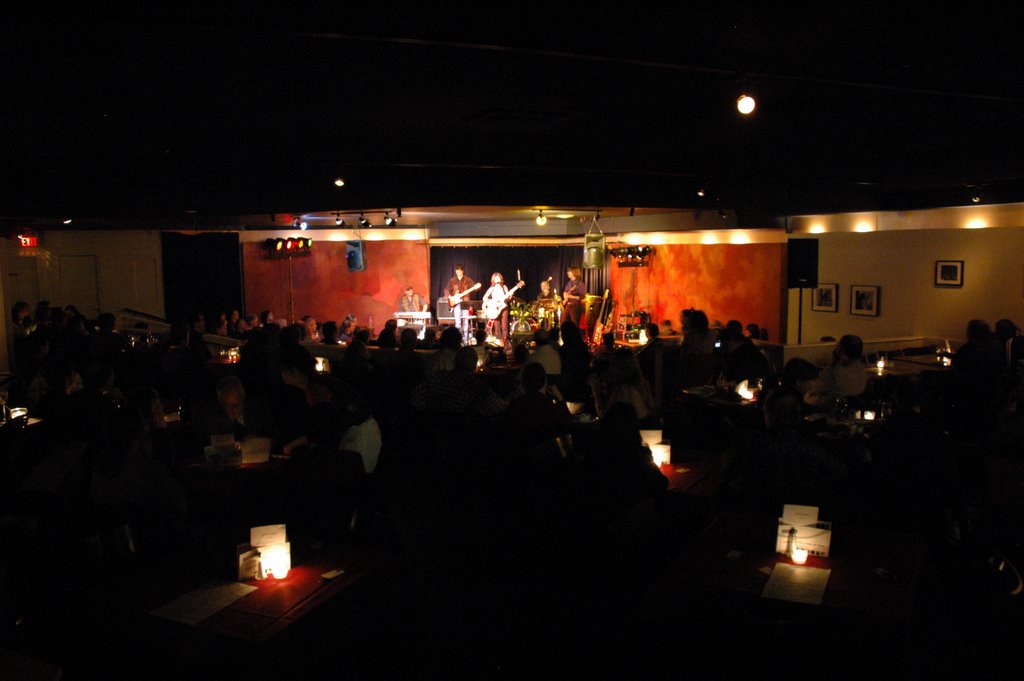
You probably can't see them in the dark, but there were people there at all those tables.
I couldn't see them either. When the lights are on you, you can't see very far ahead. Past the first row of tables, it's all fuzzy and black. You rely on the sound of applause.
My show at Hugh's Room went really well. But before the show, I was very nervous. It's unusual for me to get nervous these days, so I was annoyed at myself, which made me even more nervous. What was I nervous about? I couldn't really tell. Nothing really...and everything. Who'd show up, who wouldn't, how I'd sound...all those things, but mostly, whether I really belonged there.
It's funny...you work so hard to get to "the next level" (whatever it happens to be at the time) and then when you're there, you think maybe it's all a big mistake.
Anyway, I didn't feel like my usual confident self, and suddenly I felt a strong kinship with Carly Simon and Barbra Streisand, both of whom had stage-fright problems. (Today, 48 hours later, "Memories" has been going through my head. I'm sure that's why.)
Part of the problem was that I had not pre-planned the "before-show" time period. I had carefully mapped out every other part of the day, but had ignored the two-and-a-half hours between sound check and curtain time. As it turns out, two-and-a-half hours is a very long time, especially when you're too nervous to eat anything but a protein bar. The guitar player, Eric, kindly accompanied me to a used record store and then a cafe to kill time.
When we returned, the room was filling up, so in order to avoid socializing nervously with friends and fans before the show, I was forced to spend time wringing my hands in the little anteroom behind the club's administrative offices (which is to say, a bad place to look like a complete wreck). Just then, my producer and bass player David mentioned that I could go outside to the roof.
The roof? Where? I was practically sprinting towards it.
He led me along a zig-zag corridor through the kitchen, where the staff were merrily preparing food and listening to some other kind of music, completely oblivious to my panic.
And then, out the doorway, there it was: a blessedly open rooftop deck...the kind you find in back of so many Toronto houses, apparently even those that have been turned into restaurants.
It was cold on the rooftop, but I could pace and sing, freely and without being noticed.
Also, I could notice the moon, which was almost full, and the stars clearly visible above the city's glow. I was shivering, but I stayed as long as I could, singing for awhile but then just standing still and watching the real stars, which put my own reaching upward into perspective.
Tuesday, January 10, 2006
Lessons from Busking on the Eve of a CD Release Party
1) You never know who's going to show up.
2) Play like nobody's ever going to see you again.
3) On the other hand, nobody's paying as much attention to your performance as you are.
4) What you're doing is virtually unimportant in the big scheme of things.
5) But what you're doing is valuable and special.
6) That contradiction is funny!
7) You're always right beside the garbage bin.
8) People are asking you for directions.
9) There are always several directions to go, not just up or down.
10) It's easier to be singing than to be thinking about singing.
2) Play like nobody's ever going to see you again.
3) On the other hand, nobody's paying as much attention to your performance as you are.
4) What you're doing is virtually unimportant in the big scheme of things.
5) But what you're doing is valuable and special.
6) That contradiction is funny!
7) You're always right beside the garbage bin.
8) People are asking you for directions.
9) There are always several directions to go, not just up or down.
10) It's easier to be singing than to be thinking about singing.
Monday, January 09, 2006
The Big Small
Pape Station is a small place. It has a little name and a narrow busking space, which is, apparently, shrinking. When I returned today after an absence of several weeks, the rectangle of yellow dots designating the performance area had shrunk to maybe three feet by one foot, because a new garbage-and-recycling sorting bin had replaced the garbage can.
The sorting bin is a good thing (in fact, it seems to draw people to the immediate area) so I'm not complaining. I can still fit into the space.
This week, I've been thinking about big things! A big CD release concert! At a big venue! With a band! (That's pretty big, for me.) A few people from (small) radio stations have interviewed me about my music...giving me a chance to think big thoughts about why I wrote the songs in the first place. "Why do you write about little things?"
I answered something (off-the-cuff, not edited, not exactly right) and later found myself thinking about Mrs. Popeski and Bob Dylan.
Mrs. Popeski was my high school art teacher. She required us to create what she called "home drawings", one per week. We had to draw an object or objects in our house. Some students protested that their house was not interesting enough, but she was firm. It didn't matter how humble your environment was: if you observed it carefully, set your subject in the right light, invested time and care and improved your technique through practice, you could produce beautiful work. (This was proven true by my friend Janice, whose gorgeous drawings of objects in her famiiy's small house will someday, I predict, be worth a lot of money.)
Bob Dylan, master poet and illuminator of details, summed up the poet's eye when he wrote "In the fury of the moment, I can see the Master's hand, in every leaf that trembles and every grain of sand." In fact, I think we all can see it. But usually we don't notice it. And even if we do, we can't express that we see it so eloquently. (I certainly can't.)
But it's worth trying.
So today I returned to Pape Station, to observe the afternoon, while painting with the melodies and words I know. Once or twice, I got a phrase just right...other times, I rushed through it, missed a detail. When some people noticed me, I realized that I too am a detail, a footnote, a bit of local colour. Worth being.
Earlier today, I was feeling tense with anxiety over my upcoming "big" event (which, as I had already observed but pretended not to notice, isn't really so big at all). I calmed down only when I did something humble and easy, something virtually insignificant in the big scheme of the entertainment world.
Welcome back to the Big Small.
The sorting bin is a good thing (in fact, it seems to draw people to the immediate area) so I'm not complaining. I can still fit into the space.
This week, I've been thinking about big things! A big CD release concert! At a big venue! With a band! (That's pretty big, for me.) A few people from (small) radio stations have interviewed me about my music...giving me a chance to think big thoughts about why I wrote the songs in the first place. "Why do you write about little things?"
I answered something (off-the-cuff, not edited, not exactly right) and later found myself thinking about Mrs. Popeski and Bob Dylan.
Mrs. Popeski was my high school art teacher. She required us to create what she called "home drawings", one per week. We had to draw an object or objects in our house. Some students protested that their house was not interesting enough, but she was firm. It didn't matter how humble your environment was: if you observed it carefully, set your subject in the right light, invested time and care and improved your technique through practice, you could produce beautiful work. (This was proven true by my friend Janice, whose gorgeous drawings of objects in her famiiy's small house will someday, I predict, be worth a lot of money.)
Bob Dylan, master poet and illuminator of details, summed up the poet's eye when he wrote "In the fury of the moment, I can see the Master's hand, in every leaf that trembles and every grain of sand." In fact, I think we all can see it. But usually we don't notice it. And even if we do, we can't express that we see it so eloquently. (I certainly can't.)
But it's worth trying.
So today I returned to Pape Station, to observe the afternoon, while painting with the melodies and words I know. Once or twice, I got a phrase just right...other times, I rushed through it, missed a detail. When some people noticed me, I realized that I too am a detail, a footnote, a bit of local colour. Worth being.
Earlier today, I was feeling tense with anxiety over my upcoming "big" event (which, as I had already observed but pretended not to notice, isn't really so big at all). I calmed down only when I did something humble and easy, something virtually insignificant in the big scheme of the entertainment world.
Welcome back to the Big Small.
Subscribe to:
Posts (Atom)