One technique that I find helpful in songwriting is to imagine, especially when the work is not flowing easily, that the perfectly constructed song already exists. It’s like a crossword puzzle already devised, but with the answers not yet revealed.
During the creation of every song, there are many points at which I feel completely stumped. I tend to forget those moments later on, when the song is finished. It looks so right then, so simple in its completed form. How could it have been so hard to write?
But when I’m actually writing, I hit many roadblocks along the way. A melody I liked yesterday seems trite today. A lyric line doesn’t make sense, or seems clunky and unconversational. As I’m trying to solve the puzzle of the song, I often have to erase my previous attempts at solutions, because they’re so obviously wrong. I start over, again and again. As I do, I believe in the as-yet-unfound solution, the true song that’s yet to emerge.
But what am I’m believing in, anyway? Unlike a crossword puzzle in the newspaper, an unfinished song has no actual, pre-written solution. So, is it foolish to act as if there is one? One might think so, except that the technique seems to work. By visualizing a solution that already exists, I bring it into existence. Perhaps this is a songwriter’s take on the “law of attraction” recently popularized in “The Secret”, but expressed in many wisdom throughout the ages. Ask, and you shall receive. If you build it (believe in it) they (the answers) will come.
I do wonder, during times of creative difficulty, whether the technique will finally fail. Perhaps this song, finally, is the one that's unsolveable. But my experience as an artist has taught me otherwise.
Again and again, I find that the intended song always does exist, even if it's temporarily beyond my field of vision. When I am patient and let the words and music unfold naturally, eventually they fall into a harmonious order, which seems perfectly natural. The completed work has the sort of internal logic I associate with things like Rubik’s cubes and mathematical equations. This leads me to believe that works of art are somehow mirrors of the many other perfect and beautiful structures that also exist in the universe. As artists, we may bring about a new interpretation of that greater harmony, but it already existed before we came along. Our works of art come from us, but are independent of us.
This principle can apply to my life as well. Even if I don’t understand or fully believe that my life will ultimately grow to take on some complete and meaningful shape, I can believe that it will...and that it already does. I can consider this at times when my life seems nothing more than a tangle of disorganized scribbles on the page.
Slowly but surely, just as I grope for the right lyric or chord, I move toward my life’s destiny, in assurance that it already is fully formed and complete…and that it needs my part to fulfill its promise.
Monday, April 30, 2007


Friday, April 13, 2007
On Context and Joshua Bell
This week, I heard about an article in The Washington Post from several sources, including Bob Baker’s and Kat’s blogs. The story described an experiment in which virtuoso violinist Joshua Bell fails to attract any attention while busking at a busy subway station.
I'm interested in this subject, having written extensively (in the earlier version of this blog ) about my own busking experience on the Toronto subway system.
Lots of details in the really excellent article resonated with me. I'll admit to feeling validated when I learned that even Joshua Bell was ignored by the passing crowds (“It’s not just me!”). I noticed that our experiences were very similar. Every child responded to the music. It felt strange when songs ended and no one applauded (or even noticed).
I was glad that the writer, Gene Weingarten, raised the philosophical question: “If beautiful music reaches no one, is it still beautiful?” I maintain that it is. I thought so when I was busking, and my opinion hasn't changed. But I would rephrase the question to make it reflect the experience more accurately. “If art reaches only a few …?” For it usually does reach a few. And to those people, art is not only beautiful, it is truly rare and precious: perhaps more precious than a mass-distributed product that reaches millions.
Is the lesson of the Joshua Bell Experiment that musicians need to ensure they get good gigs? Or is the lesson that as a culture, we're losing (or have already lost) our ability to recognize and nurture beauty? In such a market-driven, popularity-contest culture, how can artists respond?
Bob writes that “it's all about context” and that independent musicians need to do everything we can to create the context in which people will see us in a positive light. But in a world dominated by high-priced entertainment products, the price of the “right context” can be high.
In Toronto, an aspiring singer named Chantal Chamandy recently paid $500,000 to put her CDs in Dollarama stores and put big advertisements all over the city. She’s also planning a big concert at the Pyramids of Egypt—fantastic context—and I’ll bet she’s paying for that. About a year ago, a guy whose name I can't remember (!) rented Roy Thomson Hall for his first gig. On a smaller scale, musicians routinely lose money to pay side musicians and book prestigious venues, and pay $20,000 or more each time to produce professional CDs. Context, context, context. We're hooked on it.
A legitimate, if unusual and even radical, approach—one in line with a more slowed-down, sustainable, community-based and earth-centred approach to life and art—is to think less about context and more about content, less about celebrity and more about service.
To consciously aim to reach fewer people more deeply.
Ideally, that happens in a place that benefits both the sender and the receiver. Maybe not a subway corridor, maybe someone's home.
When such a connection occurs, playing on the margins isn't so bad.
I'm interested in this subject, having written extensively (in the earlier version of this blog ) about my own busking experience on the Toronto subway system.
Lots of details in the really excellent article resonated with me. I'll admit to feeling validated when I learned that even Joshua Bell was ignored by the passing crowds (“It’s not just me!”). I noticed that our experiences were very similar. Every child responded to the music. It felt strange when songs ended and no one applauded (or even noticed).
I was glad that the writer, Gene Weingarten, raised the philosophical question: “If beautiful music reaches no one, is it still beautiful?” I maintain that it is. I thought so when I was busking, and my opinion hasn't changed. But I would rephrase the question to make it reflect the experience more accurately. “If art reaches only a few …?” For it usually does reach a few. And to those people, art is not only beautiful, it is truly rare and precious: perhaps more precious than a mass-distributed product that reaches millions.
Is the lesson of the Joshua Bell Experiment that musicians need to ensure they get good gigs? Or is the lesson that as a culture, we're losing (or have already lost) our ability to recognize and nurture beauty? In such a market-driven, popularity-contest culture, how can artists respond?
Bob writes that “it's all about context” and that independent musicians need to do everything we can to create the context in which people will see us in a positive light. But in a world dominated by high-priced entertainment products, the price of the “right context” can be high.
In Toronto, an aspiring singer named Chantal Chamandy recently paid $500,000 to put her CDs in Dollarama stores and put big advertisements all over the city. She’s also planning a big concert at the Pyramids of Egypt—fantastic context—and I’ll bet she’s paying for that. About a year ago, a guy whose name I can't remember (!) rented Roy Thomson Hall for his first gig. On a smaller scale, musicians routinely lose money to pay side musicians and book prestigious venues, and pay $20,000 or more each time to produce professional CDs. Context, context, context. We're hooked on it.
A legitimate, if unusual and even radical, approach—one in line with a more slowed-down, sustainable, community-based and earth-centred approach to life and art—is to think less about context and more about content, less about celebrity and more about service.
To consciously aim to reach fewer people more deeply.
Ideally, that happens in a place that benefits both the sender and the receiver. Maybe not a subway corridor, maybe someone's home.
When such a connection occurs, playing on the margins isn't so bad.
Thursday, April 12, 2007
Big Songs for Small Spaces
Recently I found myself feeling jealous of a very successful blogging songwriter who has a lot in common with me. We're about the same age, experienced performers who write thoughtful, catchy and often inspiring songs in a folk-roots-rock vein. In our blogs, we write about spirituality and personal growth. We're "seeker-songwriters". (Wow! I just made that up!) And at the moment we have similar hair.
Career and lifestyle-wise, that's where the comparisons end. Christine Kane's audience and tour schedule is about a zillion times bigger than mine. Her career is focused and intentional, and not divided up between music and Everything Else, such as a family or parallel career. In my life, there's a lot of the Everything Else these days. Make no mistake: I admire Christine, find her inspiring and recommend both her music and her blog. I'm sure she'd be the first to remind me--in her honest, funny and spiritual way--that comparing myself to others is always a bad idea!
So, now that we've gotten that out of the way...back to the life I have chosen.
A friend asked me recently what folk festivals I'll be playing this summer. I said none, which is true. My freelance writing work is active right now, and my family doesn't particularly want to traipse around the festival circuit with me. My music, for now, is staying close to home.
In fact, just the other day we were reminiscing about the "hilarious" time we all spent camping in the fog at my first and only Major Festival Appearance, at the Stan Rogers Folk Festival in Canso, Nova Scotia. I have to admit now, three years on, that the highlight of the experience for me was probably seeing my name on a t-shirt on a long list alongside Bruce Cockburn and Ron Sexsmith . The highlight certainly was not spending two uncomfortable nights with children and husband in tents while "in-their-element" touring musicians jammed until 4:00 in the morning! During the long drive home, I developed lower back problems that lasted six months. All in all, not a net gain.
So...back to the life I've chosen. (I notice that this "coming back" to my own life, after I've been derailed by comparisons, is actually like returning to the breath during meditation.)
My life is a good one...no, a great one! I am grateful for my wonderful husband, our two fantastic children (now 10 and 12, growing up fast) and well-paying writing work for socially-responsible clients. I continue to write songs prolifically and play them regularly, at a community radio station , a local cafe, our Unitarian Church and an open mic. Immediately after the Stanfest tour, I enjoyed singing part-time as a subway musician for a couple of seasons.
I try to write big songs. I find myself singing them in small spaces. Sometimes I struggle with that, even though I believe that small spaces (such as human lives), with all their constraints and compromises, are where all good songs go . No matter what size the stage, ultimately a song finds a home in one human heart at a time. While I see the need for people on big stages who inspire and motivate large numbers of people (Oprah, Al Gore), I also hope that all artists can affirm the lives we have as vehicles for beauty and growth. We long for bigger and better stages...we take a breath...we return to the place we are.
At the open mic last night, a dishevelled man shuffled in, muttering to himself as he took a handful of free cookies. I was standing beside him getting coffee when I heard him mumble, "you can sing at community centres...churches...seniors' homes...". I wondered if I had heard him right, and he repeated it. "You can sing at community centres...churches...seniors' homes." I didn't know if he was talking to himself, to me (was he quoting this blog?) or to the artists' sign-up sheet.
Part of me hoped he wasn't talking to me. A bigger part knew that he was.
Career and lifestyle-wise, that's where the comparisons end. Christine Kane's audience and tour schedule is about a zillion times bigger than mine. Her career is focused and intentional, and not divided up between music and Everything Else, such as a family or parallel career. In my life, there's a lot of the Everything Else these days. Make no mistake: I admire Christine, find her inspiring and recommend both her music and her blog. I'm sure she'd be the first to remind me--in her honest, funny and spiritual way--that comparing myself to others is always a bad idea!
So, now that we've gotten that out of the way...back to the life I have chosen.
A friend asked me recently what folk festivals I'll be playing this summer. I said none, which is true. My freelance writing work is active right now, and my family doesn't particularly want to traipse around the festival circuit with me. My music, for now, is staying close to home.
In fact, just the other day we were reminiscing about the "hilarious" time we all spent camping in the fog at my first and only Major Festival Appearance, at the Stan Rogers Folk Festival in Canso, Nova Scotia. I have to admit now, three years on, that the highlight of the experience for me was probably seeing my name on a t-shirt on a long list alongside Bruce Cockburn and Ron Sexsmith . The highlight certainly was not spending two uncomfortable nights with children and husband in tents while "in-their-element" touring musicians jammed until 4:00 in the morning! During the long drive home, I developed lower back problems that lasted six months. All in all, not a net gain.
So...back to the life I've chosen. (I notice that this "coming back" to my own life, after I've been derailed by comparisons, is actually like returning to the breath during meditation.)
My life is a good one...no, a great one! I am grateful for my wonderful husband, our two fantastic children (now 10 and 12, growing up fast) and well-paying writing work for socially-responsible clients. I continue to write songs prolifically and play them regularly, at a community radio station , a local cafe, our Unitarian Church and an open mic. Immediately after the Stanfest tour, I enjoyed singing part-time as a subway musician for a couple of seasons.
I try to write big songs. I find myself singing them in small spaces. Sometimes I struggle with that, even though I believe that small spaces (such as human lives), with all their constraints and compromises, are where all good songs go . No matter what size the stage, ultimately a song finds a home in one human heart at a time. While I see the need for people on big stages who inspire and motivate large numbers of people (Oprah, Al Gore), I also hope that all artists can affirm the lives we have as vehicles for beauty and growth. We long for bigger and better stages...we take a breath...we return to the place we are.
At the open mic last night, a dishevelled man shuffled in, muttering to himself as he took a handful of free cookies. I was standing beside him getting coffee when I heard him mumble, "you can sing at community centres...churches...seniors' homes...". I wondered if I had heard him right, and he repeated it. "You can sing at community centres...churches...seniors' homes." I didn't know if he was talking to himself, to me (was he quoting this blog?) or to the artists' sign-up sheet.
Part of me hoped he wasn't talking to me. A bigger part knew that he was.
Thursday, March 29, 2007
One Less Verse
When I write my weekly song for Take5 on CIUT 89.5 FM, I notice something interesting.
As I approach the end of the writing process, I can usually successfully complete the song by lopping off one verse. Sometimes I have to tweak the remaining verses to ensure that the song makes sense, but usually I don't have to change very much. I've now done this with many songs in a row. Just let a verse go, and voila, I'm done.
I realize that because I can do this each time, I must be doing a little more than necessary when I'm writing. I'm going a little overboard...even trying too hard, perhaps. But maybe it's important to do so.
I can't achieve the lightness and economy I'm looking for by simply under-writing. That approach feels withholding and tentative. It's better to start from too much, and then cut back, than to start with too little.
This awareness helps me with the rest of my life. I can appreciate the abundance of my life, even when it seems overly busy or somewhat cluttered, if I take the time to consciously let go of the things that don't fit.
I notice that in my life, I often "edit" without being conscious of it, and realizing only after the fact that I've chosen not to attend an event or follow up on a particular project. Sometimes when I realize I've left something unattended, I feel a twinge of guilt or panic.
Perhaps, in the same way I consciously let go of the unneeded (though interesting and clever!) verse in a song, I can honour the "task-let-go" as I release it, letting go of guilt and regret at the same time.
The stuff that stays is always what's necessary.
As I approach the end of the writing process, I can usually successfully complete the song by lopping off one verse. Sometimes I have to tweak the remaining verses to ensure that the song makes sense, but usually I don't have to change very much. I've now done this with many songs in a row. Just let a verse go, and voila, I'm done.
I realize that because I can do this each time, I must be doing a little more than necessary when I'm writing. I'm going a little overboard...even trying too hard, perhaps. But maybe it's important to do so.
I can't achieve the lightness and economy I'm looking for by simply under-writing. That approach feels withholding and tentative. It's better to start from too much, and then cut back, than to start with too little.
This awareness helps me with the rest of my life. I can appreciate the abundance of my life, even when it seems overly busy or somewhat cluttered, if I take the time to consciously let go of the things that don't fit.
I notice that in my life, I often "edit" without being conscious of it, and realizing only after the fact that I've chosen not to attend an event or follow up on a particular project. Sometimes when I realize I've left something unattended, I feel a twinge of guilt or panic.
Perhaps, in the same way I consciously let go of the unneeded (though interesting and clever!) verse in a song, I can honour the "task-let-go" as I release it, letting go of guilt and regret at the same time.
The stuff that stays is always what's necessary.
Tuesday, March 27, 2007
Rehearsing
Today I spent some time rehearsing for an upcoming show. I went through a whole set in order, which I confess is something I often don't do. It's more common for me to play a song or two...take time away for another activity...then do a couple of other songs. I can keep the songs fresh that way, but I don't experience the full flow and rhythm and shape of a whole show, which I need to do to be fully prepared. Over the last few days, I've been taking that time to rehearse the show completely.
I think of the word "rehearsing" as looking ahead to the future: preparing for a show, visualizing it in advance. But when I'm actually singing the songs on my own, today, the experience feels more like reminding or reconnecting...a referring back to songs I love and the feelings I had when I wrote them.
Just now I wondered what the origins of the word "rehearse" are. I found out something interesting. The word is said to mean "to repeat" (that's true: we repeat the songs over and over to improve our performance) but the origin of the word comes from "re" plus "hercier" which means "to strike" or (here's the interesting part) "to harrow".
"Harrow", a word I wasn't familiar with, is an agricultural term referring to a tool with spikelike teeth which is drawn over plowed land to level it, or break up clods, root up weeds and so on.
So...to rehearse, then, is to re-disturb the earth...to unearth again..to stir up deep-rooted feelings that have perhaps been smoothed over or tamped down under the pressure of our daily walk.
Now that's more like it...that's what rehearsal feels like to me.
It feels like digging in the ground and finding something new again.
I think of the word "rehearsing" as looking ahead to the future: preparing for a show, visualizing it in advance. But when I'm actually singing the songs on my own, today, the experience feels more like reminding or reconnecting...a referring back to songs I love and the feelings I had when I wrote them.
Just now I wondered what the origins of the word "rehearse" are. I found out something interesting. The word is said to mean "to repeat" (that's true: we repeat the songs over and over to improve our performance) but the origin of the word comes from "re" plus "hercier" which means "to strike" or (here's the interesting part) "to harrow".
"Harrow", a word I wasn't familiar with, is an agricultural term referring to a tool with spikelike teeth which is drawn over plowed land to level it, or break up clods, root up weeds and so on.
So...to rehearse, then, is to re-disturb the earth...to unearth again..to stir up deep-rooted feelings that have perhaps been smoothed over or tamped down under the pressure of our daily walk.
Now that's more like it...that's what rehearsal feels like to me.
It feels like digging in the ground and finding something new again.
Thursday, March 22, 2007
Delegating to the Unconscious Mind
I notice that when I wake up in the morning, I often have lyrics clear and ready to go, ones that I might have been fruitlessly working on the night before. When I wake up, my mind is refreshed and clear, my ideas lucid and flowing.
On any given day, I'll be working on a variety of diverse tasks--everything from writing a song to planning dinner to researching an article. I like being busy. Also, I like the fact that cross-pollination occurs between projects and even across disciplines. For example, the newsletter story I'm writing for the YMCA may give me an idea for whatever song is underway.
But on the other hand, sometimes this bubbling-over of creativity can turn into a sort of "idea clutter" that backfires. It tends to happen when I start to worry about whether I can handle many tasks at once. That fearful thought has nothing to do with whether or not such complexity and creativity is possible (because it usually is) but it certainly can get in the way of bringing it to fruition.
Starting from that worried "how will I do this?" place, I often start to unconciously "multi-task". Even as I'm congratulating myself for being so all-powerful and creative, I'm grabbing onto more and more threads of interest and concern, instead of gently noticing each task and stepping lightly from one to another. Before I know it, I'm feeling overstretched, inadequate and anxious...a big unproductive ball of fear.
If I find ways to clear my mind periodically, through a brief meditation, a walk, or simply noticing the thought and letting it go, I allow my unconscious mind to do the work for me. Pema Chodron recommends that we notice a thought and label it, "thinking". My worry ("I need a rhyming line for the bridge!" or "Oh no, I have to finish this article by Wednesday!") is not a real and scary thing. It's a thought. I can notice it and let it go.
Noticing the natural, unthinking abundance of the natural world helps me trust that my unconscious mind does know how to create. If I work with it, in a playful dance of conscious and unconscious awareness, I find myself being more productive and more calm.
On any given day, I'll be working on a variety of diverse tasks--everything from writing a song to planning dinner to researching an article. I like being busy. Also, I like the fact that cross-pollination occurs between projects and even across disciplines. For example, the newsletter story I'm writing for the YMCA may give me an idea for whatever song is underway.
But on the other hand, sometimes this bubbling-over of creativity can turn into a sort of "idea clutter" that backfires. It tends to happen when I start to worry about whether I can handle many tasks at once. That fearful thought has nothing to do with whether or not such complexity and creativity is possible (because it usually is) but it certainly can get in the way of bringing it to fruition.
Starting from that worried "how will I do this?" place, I often start to unconciously "multi-task". Even as I'm congratulating myself for being so all-powerful and creative, I'm grabbing onto more and more threads of interest and concern, instead of gently noticing each task and stepping lightly from one to another. Before I know it, I'm feeling overstretched, inadequate and anxious...a big unproductive ball of fear.
If I find ways to clear my mind periodically, through a brief meditation, a walk, or simply noticing the thought and letting it go, I allow my unconscious mind to do the work for me. Pema Chodron recommends that we notice a thought and label it, "thinking". My worry ("I need a rhyming line for the bridge!" or "Oh no, I have to finish this article by Wednesday!") is not a real and scary thing. It's a thought. I can notice it and let it go.
Noticing the natural, unthinking abundance of the natural world helps me trust that my unconscious mind does know how to create. If I work with it, in a playful dance of conscious and unconscious awareness, I find myself being more productive and more calm.
Sunday, March 11, 2007
The Next Level
A few days ago I was in a roomful of musicians, listening to the brilliantly engaging Derek Sivers of CD Baby share what he knows about the independent music business (which is to say, a whole lot). While candidly sharing his wealth of knowledge, he invited the people in the room to introduce themselves and connect with others who might be able to help them in their careers.
So, people started introducing themselves to the warm, supportive and very crowded room. Some said they wanted to take their careers "to the next level".
I just searched the phrase "take your music career to the next level" on Google. It returned 5,510,000 entries.
Even if we didn't hear that phrase so often in independent music, it would be natural for us to think in terms of "levels". From the time we're kids, we focus on grades of achievement and levels of status, income and success.
Unfortunately, most creative careers don't ascend those levels in predictable ways. Even the most highly-skilled musicians find themselves in a fragmented marketplace that cannot financially support them. Today, the commercial music industry is in decline, at the same time more independent musicians are in business.
So, what if there's no "next level"?
For many of us, there will not be. Our audience will remain more or less the size it is now. We will not receive the critical praise we seek or feel we deserve. We will not be able to support ourselves on our creative work. Some of this may be our own doing, as we fail to achieve certain artistic or business skills, or choose to spend time raising a family or maintaining another source of income. Other factors may be completely beyond our control, such as the current state of the music industry.
Needless to say, if we're unable to rise to "the next level", we're not alone among artists, either today or throughout history.
But if there is no next level, there may be a silver lining. In fact, as Thomas Moore writes in his book Care of the Soul, "failure is a mystery, not a problem". As a mystery, it can deepen the heart and soul...strengthening our song and preventing us from wallowing in self-pity or clinging to fantasies.
Once out of the picture, perhaps "the next level" can be replaced with a deeper commitment to artistic practice itself, to service to others, to the present moment, to life itself.
A technique I often use in performance is to imagine that the song I'm singing is the last I will ever sing. I find that that perspective gives me renewed energy and focus, and I often use it when I feel I am losing ground...not quite hitting the mark.
It allows me to let go of the next level--even the next moment--and simply give what I have. Now. And without expectation.
So, people started introducing themselves to the warm, supportive and very crowded room. Some said they wanted to take their careers "to the next level".
I just searched the phrase "take your music career to the next level" on Google. It returned 5,510,000 entries.
Even if we didn't hear that phrase so often in independent music, it would be natural for us to think in terms of "levels". From the time we're kids, we focus on grades of achievement and levels of status, income and success.
Unfortunately, most creative careers don't ascend those levels in predictable ways. Even the most highly-skilled musicians find themselves in a fragmented marketplace that cannot financially support them. Today, the commercial music industry is in decline, at the same time more independent musicians are in business.
So, what if there's no "next level"?
For many of us, there will not be. Our audience will remain more or less the size it is now. We will not receive the critical praise we seek or feel we deserve. We will not be able to support ourselves on our creative work. Some of this may be our own doing, as we fail to achieve certain artistic or business skills, or choose to spend time raising a family or maintaining another source of income. Other factors may be completely beyond our control, such as the current state of the music industry.
Needless to say, if we're unable to rise to "the next level", we're not alone among artists, either today or throughout history.
But if there is no next level, there may be a silver lining. In fact, as Thomas Moore writes in his book Care of the Soul, "failure is a mystery, not a problem". As a mystery, it can deepen the heart and soul...strengthening our song and preventing us from wallowing in self-pity or clinging to fantasies.
Once out of the picture, perhaps "the next level" can be replaced with a deeper commitment to artistic practice itself, to service to others, to the present moment, to life itself.
A technique I often use in performance is to imagine that the song I'm singing is the last I will ever sing. I find that that perspective gives me renewed energy and focus, and I often use it when I feel I am losing ground...not quite hitting the mark.
It allows me to let go of the next level--even the next moment--and simply give what I have. Now. And without expectation.
Saturday, March 03, 2007
Embracing Limitation
At a songwriting workshop recently, I found myself telling the students that sometimes the “problems” that arise in songs actually turn out to be blessings. The length of phrases can be challenging, for instance, as I try to fit a complicated idea into only 12 syllables. (Maybe the idea’s too complicated.) Or perhaps there’s a line I’m hooked on that ends in a word like “orange”. (When I rewrite the line, I find my meaning is clearer—and a rhyme is there.)
Songs can be maddeningly confining structures at times, especially when we feel like letting our emotions hang out and telling our life stories in song. Songs don’t let us do that in an undisciplined way. If we ignore the demands of structure, we end up with sprawling, unfocused writing that no one (not even we) want to listen to again. The process might be cathartic, but the results will not be inspiring.
I’ve come to appreciate the limitations offered by songs; it’s the limitations of life that sometimes get me down. I sometimes feel frustrated that I don’t have more time to create, and complain that it’s impossible to meet multiple demands of work, family and art at the same time. It reminds me of being stuck on a lyric. How can I possibility fit everything into one short lyric phrase (that is my life)? Where’s the rhyme (and the source of harmony in my day)? What’s this song really about?
I’ve heard it said that art is a microcosm of life: we re-create the universe in miniature each time we paint a picture or write a song. The structures of art mirror those of the natural world—and perhaps one reason we are so moved by art is that it reminds us of the infinite amount of creative possibility contained within the limitations we all share. We all have limited time, limited resources. But, listen…so does this song. But, look…so does this painting.
By appreciating the blessings contained in the constraints of my art form, I can begin to appreciate that perhaps the structures of my life (work, family, marriage…) are not limitations, but blessings. By understanding that my life is “framed” in certain ways, I can make better use of the space within it.
Songs can be maddeningly confining structures at times, especially when we feel like letting our emotions hang out and telling our life stories in song. Songs don’t let us do that in an undisciplined way. If we ignore the demands of structure, we end up with sprawling, unfocused writing that no one (not even we) want to listen to again. The process might be cathartic, but the results will not be inspiring.
I’ve come to appreciate the limitations offered by songs; it’s the limitations of life that sometimes get me down. I sometimes feel frustrated that I don’t have more time to create, and complain that it’s impossible to meet multiple demands of work, family and art at the same time. It reminds me of being stuck on a lyric. How can I possibility fit everything into one short lyric phrase (that is my life)? Where’s the rhyme (and the source of harmony in my day)? What’s this song really about?
I’ve heard it said that art is a microcosm of life: we re-create the universe in miniature each time we paint a picture or write a song. The structures of art mirror those of the natural world—and perhaps one reason we are so moved by art is that it reminds us of the infinite amount of creative possibility contained within the limitations we all share. We all have limited time, limited resources. But, listen…so does this song. But, look…so does this painting.
By appreciating the blessings contained in the constraints of my art form, I can begin to appreciate that perhaps the structures of my life (work, family, marriage…) are not limitations, but blessings. By understanding that my life is “framed” in certain ways, I can make better use of the space within it.
Wednesday, February 28, 2007
Performance Anxiety
Some time ago, a friend turned to me warmly and said "I'm sure you don't get nervous before shows anymore."
Of course I smiled confidently back and said, "Well, no, not really." Inwardly, though, I knew it wasn't true.
I do suffer from performance anxiety. I do even though I have the tools not to, when I've done my reading, when I'm approaching the show from a good and generous place, when I'm reasonably well-rested. In the twelve hours or so leading up to a performance, I feel queasy, jumpy and generally on edge. I find it difficult to eat. So there. I've admitted it.
And that's a good thing to do. It's helpful to admit it, accept it, acknowledge the feelings. Yes, I am nervous about tonight's show. It's not right or wrong, and it doesn't say a thing about my skill or experience or mental health. It simply is.
That's the first thing to do. Admit it.
Next, once I've stopped trying to deny the anxiety, I pause and breathe. I reframe. I am well in this moment. When an anxious thought crosses my mind, I notice it and let it go. If possible, I take 15 minutes or so to actually meditate, with a candle and calming music.
During the day of the show, I tend to rehearse a bit, not to learn to play the songs better (that's what the rehearsals leading up to today were for) but to remind myself that I love the songs. I do love them. When I sing them, I feel great...not anxious in the least. And when I'm singing them for others I feel even better. So I rehearse to get in tune with what I love.
Once I've reconnected with what I love about what I do, I decide to simply serve others tonight, to the best of my ability. That's what the songs are for: to make people feel better. Once I've decided to serve, I let go of my expectations, and simply show up and play my part.
It turns out that the theme of tonight's show is Love. As I was preparing for it, I came across this prayer in Marianne Williamson's book "A Return to Love":
"Dear God, please give my life some sense of purpose. Use me as an instrument of your peace. Use my talents and abilities to spread love. I surrender my job to you. Help me to remember that my real job is to love the world back to health. Thank you very much. Amen."
Of course I smiled confidently back and said, "Well, no, not really." Inwardly, though, I knew it wasn't true.
I do suffer from performance anxiety. I do even though I have the tools not to, when I've done my reading, when I'm approaching the show from a good and generous place, when I'm reasonably well-rested. In the twelve hours or so leading up to a performance, I feel queasy, jumpy and generally on edge. I find it difficult to eat. So there. I've admitted it.
And that's a good thing to do. It's helpful to admit it, accept it, acknowledge the feelings. Yes, I am nervous about tonight's show. It's not right or wrong, and it doesn't say a thing about my skill or experience or mental health. It simply is.
That's the first thing to do. Admit it.
Next, once I've stopped trying to deny the anxiety, I pause and breathe. I reframe. I am well in this moment. When an anxious thought crosses my mind, I notice it and let it go. If possible, I take 15 minutes or so to actually meditate, with a candle and calming music.
During the day of the show, I tend to rehearse a bit, not to learn to play the songs better (that's what the rehearsals leading up to today were for) but to remind myself that I love the songs. I do love them. When I sing them, I feel great...not anxious in the least. And when I'm singing them for others I feel even better. So I rehearse to get in tune with what I love.
Once I've reconnected with what I love about what I do, I decide to simply serve others tonight, to the best of my ability. That's what the songs are for: to make people feel better. Once I've decided to serve, I let go of my expectations, and simply show up and play my part.
It turns out that the theme of tonight's show is Love. As I was preparing for it, I came across this prayer in Marianne Williamson's book "A Return to Love":
"Dear God, please give my life some sense of purpose. Use me as an instrument of your peace. Use my talents and abilities to spread love. I surrender my job to you. Help me to remember that my real job is to love the world back to health. Thank you very much. Amen."
Tuesday, February 27, 2007
World View in a Set List
When songs are put together in a grouping, such as a set list, it's possible to see patterns emerge. Certain themes come up again and again. Particular chords are favoured. Melody lines are related. Sometimes songs seem to comment or refer to other songs. Recently the painter Robert Genn suggested in a letter that the same thing happens in painting. Artists are constantly "filling in the blanks" of a cohesive body of work or individual way of seeing the world.
I imagine this as if it's a jigsaw puzzle, but without the handy box-top that shows us the ultimate finished design. We don't know what the end is going to be. Is the puzzle going to be "solved", the picture "finished", the body of work complete by the time our life ends? Is the unfinishedness part of the picture? Are the gaps part of the answer to the puzzle?
One of the beautiful paradoxes of creative expression is that it helps to pay attention to both the "big picture" and the "little picture", and that it's difficult to do these two things simultaneously. As one spiritual teacher I know might say, "It takes practice".
When I'm thinking too much on the big intentions, lofty visions of my body of work and so on, I lose sight of the individual song or for that matter the individual note or chord. Only by paying close attention to them, by serving them in fact, can I lovingly coax a beautiful song into being.
On the other hand, when I take time to contemplate what the bigger picture on the boxtop might be--what is my concept of God, for instance, and what missing piece of the Universe may I be able to provide--the songs are stronger individually, they fit beautifully into cohesive set lists, and they are more useful in my life and the lives of others.
I imagine this as if it's a jigsaw puzzle, but without the handy box-top that shows us the ultimate finished design. We don't know what the end is going to be. Is the puzzle going to be "solved", the picture "finished", the body of work complete by the time our life ends? Is the unfinishedness part of the picture? Are the gaps part of the answer to the puzzle?
One of the beautiful paradoxes of creative expression is that it helps to pay attention to both the "big picture" and the "little picture", and that it's difficult to do these two things simultaneously. As one spiritual teacher I know might say, "It takes practice".
When I'm thinking too much on the big intentions, lofty visions of my body of work and so on, I lose sight of the individual song or for that matter the individual note or chord. Only by paying close attention to them, by serving them in fact, can I lovingly coax a beautiful song into being.
On the other hand, when I take time to contemplate what the bigger picture on the boxtop might be--what is my concept of God, for instance, and what missing piece of the Universe may I be able to provide--the songs are stronger individually, they fit beautifully into cohesive set lists, and they are more useful in my life and the lives of others.
Saturday, February 24, 2007
How long it takes
There’s a theory among songwriters that the faster a song is written, the better it probably is. Great songs such as Amanda McBroom's “The Rose” and Shirley Eikhard's “Something to Talk About” were said to be written quickly, and many of my best songs were too. The song seems to arrive fully formed, often taking shape in under a half-hour, and then all you have to do is tweak! It’s wonderful when that happens.
But sometimes it doesn’t. If I don’t have a deadline or reason to finish a song, I often abandon it if it’s taking more than a few days. I simply lose interest in it or it slips my mind or a new idea arises that I like better.
This week, because I was writing to a deadline, I had to stick with the project and not abandon ship. The song wasn’t a “quickie”. It took perhaps 10 or 15 hours, compressed over two rather uncomfortable days. During the process, I threw out two half-written drafts before finally landing on a concept for the song I liked.
What was “wrong” about the drafts I threw out? On the surface, not much. One of them was bold and catchy, the other sweetly lyrical. But something didn't sit right with me...and while deep in creative mode that's all I knew. It took a few days to see clearly that one was written in a detached, objective and preachy-sounding tone…and the other one, though pretty, seemed to lack confidence. (No doubt because I was taking so long to finish the song.)
Confidence is everything. And sometimes it’s important to have the confidence to NOT create fast. To take the time you need to experiment, get it wrong, throw it out. On my third try, I had a much better understanding of what I was trying to accomplish and the song was written successfully.
But sometimes it doesn’t. If I don’t have a deadline or reason to finish a song, I often abandon it if it’s taking more than a few days. I simply lose interest in it or it slips my mind or a new idea arises that I like better.
This week, because I was writing to a deadline, I had to stick with the project and not abandon ship. The song wasn’t a “quickie”. It took perhaps 10 or 15 hours, compressed over two rather uncomfortable days. During the process, I threw out two half-written drafts before finally landing on a concept for the song I liked.
What was “wrong” about the drafts I threw out? On the surface, not much. One of them was bold and catchy, the other sweetly lyrical. But something didn't sit right with me...and while deep in creative mode that's all I knew. It took a few days to see clearly that one was written in a detached, objective and preachy-sounding tone…and the other one, though pretty, seemed to lack confidence. (No doubt because I was taking so long to finish the song.)
Confidence is everything. And sometimes it’s important to have the confidence to NOT create fast. To take the time you need to experiment, get it wrong, throw it out. On my third try, I had a much better understanding of what I was trying to accomplish and the song was written successfully.
Friday, February 02, 2007
The Cure
This week was going to be tough for writing a song. My husband's grandmother, whom we dearly loved, died on Monday. We had the visitation and the funeral to deal with, and much of the week seemed to be covered over by a heavy blanket of loss.
I thought it might be impossible for me to write my weekly song, so I notified the producer who naturally let me off the hook.
Still, it nagged at me. Would I feel better NOT writing a song...or writing a song?
One of the topics this week was Emily Carr, the Canadian painter (d. 1945) known for dramatic depictions of the British Columbia wilderness and the art of the Haida First Nation. The Art Gallery of Ontario will host a retrospective exhibition of her work in March. I have always found her art and her life story inspiring. At one point, her art career was so unsuccessful she dropped painting altogether for 15 years and worked at a series of unrelated jobs. Lawren Harris of the Group of Seven encouraged her and she resumed painting and finally did receive critical recognition...but for many years she had to contend with doubt, failure and isolation. Despite this, or more likely because of it, her paintings have a powerful spiritual dimension, reflecting her fierce determination to share her passion for the land with others.
I figured I could write a song about that, so I started one called "Emily in the Big Woods".
But it couldn't be finished by Friday. Wrestling with the subject, I found inspiration in Emily Carr's writing too. (She wrote many books and constantly reflected on her creative life. She would have been a blogger.) "I thought my mountain was coming this morning. It was near to speaking when suddenly it shifted, sulked, and returned to smallness. It has eluded me again and sits there, puny and dull. Why? " So. She would understand that some subjects take more time than others.
Oregano, on the other hand, works fast.
Oregano, or oregano oil to be more precise, is a natural cure-all that probably is very good for you. I've never tried it...but I sure do like my Cold-FX. Oregano oil promises to do much the same thing...boost the immune system...ward off colds and flues.
The word "oregano" rhymes with lots of fun things, I discovered. And it was time for a fun song.
After many drafts, I ended up assembling the song while watching Calla's swimming lesson yesterday night. As always, the feeling of satisfaction was huge when I finally slotted all the rhyming couplets into their correct order, to form a song exactly 3:00 in length. It feels like solving a Rubik's cube or a crossword puzzle (neither of which I can do).
Oregano lifted the blanket of woe that had fallen over our week. Listen!
I thought it might be impossible for me to write my weekly song, so I notified the producer who naturally let me off the hook.
Still, it nagged at me. Would I feel better NOT writing a song...or writing a song?
One of the topics this week was Emily Carr, the Canadian painter (d. 1945) known for dramatic depictions of the British Columbia wilderness and the art of the Haida First Nation. The Art Gallery of Ontario will host a retrospective exhibition of her work in March. I have always found her art and her life story inspiring. At one point, her art career was so unsuccessful she dropped painting altogether for 15 years and worked at a series of unrelated jobs. Lawren Harris of the Group of Seven encouraged her and she resumed painting and finally did receive critical recognition...but for many years she had to contend with doubt, failure and isolation. Despite this, or more likely because of it, her paintings have a powerful spiritual dimension, reflecting her fierce determination to share her passion for the land with others.
I figured I could write a song about that, so I started one called "Emily in the Big Woods".
But it couldn't be finished by Friday. Wrestling with the subject, I found inspiration in Emily Carr's writing too. (She wrote many books and constantly reflected on her creative life. She would have been a blogger.) "I thought my mountain was coming this morning. It was near to speaking when suddenly it shifted, sulked, and returned to smallness. It has eluded me again and sits there, puny and dull. Why? " So. She would understand that some subjects take more time than others.
Oregano, on the other hand, works fast.
Oregano, or oregano oil to be more precise, is a natural cure-all that probably is very good for you. I've never tried it...but I sure do like my Cold-FX. Oregano oil promises to do much the same thing...boost the immune system...ward off colds and flues.
The word "oregano" rhymes with lots of fun things, I discovered. And it was time for a fun song.
After many drafts, I ended up assembling the song while watching Calla's swimming lesson yesterday night. As always, the feeling of satisfaction was huge when I finally slotted all the rhyming couplets into their correct order, to form a song exactly 3:00 in length. It feels like solving a Rubik's cube or a crossword puzzle (neither of which I can do).
Oregano lifted the blanket of woe that had fallen over our week. Listen!
Thursday, January 18, 2007
Go Thistles!
Here's a confession. I've never written a historical song, and I've never written a song about hockey.
Two risky admissions for a Canadian roots music performer.
That all changed this week, when I had to write another song for Take5. I think this is week, uh, 14? No, it's 15. I'm starting to lose track.
This week the pickings were looking a little, well, serious. Should I write about Rumi, the ancient Persian mystic (who is being commemorated in a concert this weekend)? Does anything rhyme with Rumi? Hmmm...
Then I visited the classy and inviting website of the Kenora Thistles, the team of seven speedy sportsmanlike players who won the Stanley Cup in 1907. Could I (non-hockey playing person) write a good song about that?
Turned out, I could. And I had a great time doing it.
I enjoyed fitting the players' names into a verse.
I enjoyed singing the phrase "right here in Kenora". (That's a lovely, lyrical name for a town. Much better than the previous name, "Rat Portage", which would have killed the song right there. So, where did the name "Kenora" come from anyway? Here's what Wikipedia says: "Rat Portage transformed into Kenora after amalgamating with the two neighbouring townships of Keewatin and Norman in 1904. A name change was in order for the new town; something encompassing all three of the new areas. Kenora formed from the first two letters of each area: KEewatin, NOrman, and RAt Portage: Kenora." I did not know that.)
And I enjoyed linking that 100-year old event with today in the song, by suggesting that the singer could possibly be the child of a player on the original team, now a grandparent of a young hockey player. The circle of life...the circle of hockey.
Here's something I meant to say in the interview which we pre-taped tonight.
"Go Thistles!!"
Because on Saturday, January 20th, 2007, they'll hold a commemorative game, with special guest players including Bryan Trottier, Dale Hawerchuck and Hayley Wickenheiser. Having lived and breathed this song for the past 36 hours, I am so there...
Here's the song.
Two risky admissions for a Canadian roots music performer.
That all changed this week, when I had to write another song for Take5. I think this is week, uh, 14? No, it's 15. I'm starting to lose track.
This week the pickings were looking a little, well, serious. Should I write about Rumi, the ancient Persian mystic (who is being commemorated in a concert this weekend)? Does anything rhyme with Rumi? Hmmm...
Then I visited the classy and inviting website of the Kenora Thistles, the team of seven speedy sportsmanlike players who won the Stanley Cup in 1907. Could I (non-hockey playing person) write a good song about that?
Turned out, I could. And I had a great time doing it.
I enjoyed fitting the players' names into a verse.
I enjoyed singing the phrase "right here in Kenora". (That's a lovely, lyrical name for a town. Much better than the previous name, "Rat Portage", which would have killed the song right there. So, where did the name "Kenora" come from anyway? Here's what Wikipedia says: "Rat Portage transformed into Kenora after amalgamating with the two neighbouring townships of Keewatin and Norman in 1904. A name change was in order for the new town; something encompassing all three of the new areas. Kenora formed from the first two letters of each area: KEewatin, NOrman, and RAt Portage: Kenora." I did not know that.)
And I enjoyed linking that 100-year old event with today in the song, by suggesting that the singer could possibly be the child of a player on the original team, now a grandparent of a young hockey player. The circle of life...the circle of hockey.
Here's something I meant to say in the interview which we pre-taped tonight.
"Go Thistles!!"
Because on Saturday, January 20th, 2007, they'll hold a commemorative game, with special guest players including Bryan Trottier, Dale Hawerchuck and Hayley Wickenheiser. Having lived and breathed this song for the past 36 hours, I am so there...
Here's the song.
Friday, January 05, 2007
Meltdown
This was the first week that I thought I might not be able to achieve my weekly song.
We took a break over the official holiday period (they ran the studio-recorded version of "Vessie Outshining the Moon") but this week was "business as usual"...for everyone but me it seemed.
This week, all of my responsibilities seemed to barge in at once like guests to a Christmas party: freelance writing work for the YMCA and a condominium developer, children home from school and parents visiting from Winnipeg, holiday parties to attend, gifts to buy and distribute, friends to host for dinner...and a song to write for Take 5.
I felt, as I always do when I host a party of any kind, that I couldn't give adequate attention to any of these. In addition, and putting my relatively minor stresses into perspective, we learned that a friend had died after living with AIDS for many years, and that a couple we know is divorcing.
When it came to song topics, the one most on my mind was International Polar Year and global warming, which had been covered in depth on Tuesday's show. As the icecaps melt, temperatures in Toronto continue to soar well above freezing. Ski hills remain closed. And we're all walking around in a state of low-level anxiety.
On Wednesday, all the pressure of everything became too much for me. I cracked, and started to write an email saying that I had to take the week off. I couldn't possibly write a song this week, because I was much too busy.
That's when it hit me. I was having a meltdown.
The only thing to do was stop, breathe, observe. Make the connection between the state of my life and the state of the planet's. Write the song.
We took a break over the official holiday period (they ran the studio-recorded version of "Vessie Outshining the Moon") but this week was "business as usual"...for everyone but me it seemed.
This week, all of my responsibilities seemed to barge in at once like guests to a Christmas party: freelance writing work for the YMCA and a condominium developer, children home from school and parents visiting from Winnipeg, holiday parties to attend, gifts to buy and distribute, friends to host for dinner...and a song to write for Take 5.
I felt, as I always do when I host a party of any kind, that I couldn't give adequate attention to any of these. In addition, and putting my relatively minor stresses into perspective, we learned that a friend had died after living with AIDS for many years, and that a couple we know is divorcing.
When it came to song topics, the one most on my mind was International Polar Year and global warming, which had been covered in depth on Tuesday's show. As the icecaps melt, temperatures in Toronto continue to soar well above freezing. Ski hills remain closed. And we're all walking around in a state of low-level anxiety.
On Wednesday, all the pressure of everything became too much for me. I cracked, and started to write an email saying that I had to take the week off. I couldn't possibly write a song this week, because I was much too busy.
That's when it hit me. I was having a meltdown.
The only thing to do was stop, breathe, observe. Make the connection between the state of my life and the state of the planet's. Write the song.
Thursday, December 14, 2006
Optimistic Songs
Like other works of art, songs have outlooks or moods. They can be "light" or "dark", optimistic or pessimistic.
Recently I was corresponding with a painter who told me that he could track the restless periods in his life by looking at his paintings. The moods on the canvas reflected the moods of his life, changing in rhythm from agitated to calm and back again.
I suspected I could find that kind of pattern in my body of work too. Yesterday I realized I was right, and I noticed an important twist. For me, the darker the mood, the brighter the song. (I'm sure there are exceptions to this...but there's a trend. I really remember feeling awful, for example, when I wrote "Einstein's Brain" [angry] and "When I Walk I Run" [sad].)
Yesterday I was writing this week's song for CIUT, with two candidates half-written. One had a dark mood, was set in a minor key, and had a serious political intent. Because I was struggling with my own dark mood, I found myself getting bogged down in it. It was striking me as ponderous and difficult and edgy (much like me actually). I put the song aside. But, unlike at other similar times, I didn't automatically think "it's not a good song". I just set it aside and started writing something I wanted to hear instead.
That "something" was very hopeful and optimistic. It's in a major key and is upbeat and affirming. Also, without any conscious intent on my part, the song ended up underlining the work of my friend Carol Kilby at The Gaia Centre in Haliburton, Ontario ("Work Like You Don't Need the Money"). Through the creative process, I made uplifting music that made me feel better and wrote lyrics that pointed me in a healthy direction.
This morning, I checked in with "the other song", thinking that perhaps it wasn't any good. To my surprise, it IS good! (Just as human beings still are, when they're feeling "bad".) Feeling more balanced today, I found I could work with it without being overwhelmed by its darker themes.
Tomorrow's song for Take5 is called "I'm Going to Work Forever", inspired by a story about the end of mandatory retirement at age 65 in Ontario. You can listen to it live tomorrow on Take5 on the Internet, or in Toronto at 89.5 FM.
Recently I was corresponding with a painter who told me that he could track the restless periods in his life by looking at his paintings. The moods on the canvas reflected the moods of his life, changing in rhythm from agitated to calm and back again.
I suspected I could find that kind of pattern in my body of work too. Yesterday I realized I was right, and I noticed an important twist. For me, the darker the mood, the brighter the song. (I'm sure there are exceptions to this...but there's a trend. I really remember feeling awful, for example, when I wrote "Einstein's Brain" [angry] and "When I Walk I Run" [sad].)
Yesterday I was writing this week's song for CIUT, with two candidates half-written. One had a dark mood, was set in a minor key, and had a serious political intent. Because I was struggling with my own dark mood, I found myself getting bogged down in it. It was striking me as ponderous and difficult and edgy (much like me actually). I put the song aside. But, unlike at other similar times, I didn't automatically think "it's not a good song". I just set it aside and started writing something I wanted to hear instead.
That "something" was very hopeful and optimistic. It's in a major key and is upbeat and affirming. Also, without any conscious intent on my part, the song ended up underlining the work of my friend Carol Kilby at The Gaia Centre in Haliburton, Ontario ("Work Like You Don't Need the Money"). Through the creative process, I made uplifting music that made me feel better and wrote lyrics that pointed me in a healthy direction.
This morning, I checked in with "the other song", thinking that perhaps it wasn't any good. To my surprise, it IS good! (Just as human beings still are, when they're feeling "bad".) Feeling more balanced today, I found I could work with it without being overwhelmed by its darker themes.
Tomorrow's song for Take5 is called "I'm Going to Work Forever", inspired by a story about the end of mandatory retirement at age 65 in Ontario. You can listen to it live tomorrow on Take5 on the Internet, or in Toronto at 89.5 FM.
Friday, December 01, 2006
What is the World Coming To?
This week for CIUT 89.5 fm's morning show Take 5 I was encouraged to write a song in honour of upcoming Global Orgasm Day on December 22nd. Last week, one of the show's reporters interviewed the founders of the first-annual event. They are a free-spirited and loving couple in San Francisco, both seniors, who invite everyone in the world to envision world peace while participating in an unprecedented surge of coordinated positive energy.
Now THIS is a song topic!
At first, I figured I'd simply roll with the double-entendres and the giggles, maybe throw the "F Word" into a lyric (rhymes with luck, buck, roll in the muck...) and have a good ol' romp in the studio on Friday, the climax of the week.
Then a funny thing happened. I went to the Global O website and saw how serious it is...and realized I couldn't make fun of it in good conscience.
I also realized, as I started to write, that it's a lot easier to write a good song about two people (even if they're fictional) as it is to write a song about Everyone-In-the-World-All-Longing-for-World-Peace. (Or, for that matter, to attempt to write the official Global O theme song.) Because my weekly task is to write a good song, fast, I can't hold out for "Imagine". I have to write something simple and immediate and true. This is an excellent rule-of-thumb for the successful writing of any song. Keep it simple. Start small and build up.
I started with several "small" ideas, and started assembling. The ideas were:
1) one clever lyric that said something meaningful ("what is the world coming to?", a pun which refers to both orgasm and the complexity of world problems), 2) a romantically bluesy chord change (because I wanted the song to sound sexy), 3) the notion of how this might concern one couple, not the whole world, and 4) the Internet. Why the Internet? Because this is the sort of story people exchange links over and laugh about from the remove of e-mail. I have always wanted to successfully make reference to e-mail in a song. (After hundreds of songs written about telephone conversations, it's about time.)
When I start with a combination of strong song elements like that, the creative process generally kicks into gear. Then, often, the song turns out to be something surprising and unexpected.
In this case, "What is the World Coming To?" turned out to be not upbeat and funny, but somewhat bittersweet...hopeful yet sad. And that seems right to me. Our lives (and loves) are seldom simple...and they blend pleasure and pain in all kinds of ever-changing and dynamic ways. That's true of our relationship with the planet as well as with each other.
(You can find the song to listen or download in Take5's archives.)
Now THIS is a song topic!
At first, I figured I'd simply roll with the double-entendres and the giggles, maybe throw the "F Word" into a lyric (rhymes with luck, buck, roll in the muck...) and have a good ol' romp in the studio on Friday, the climax of the week.
Then a funny thing happened. I went to the Global O website and saw how serious it is...and realized I couldn't make fun of it in good conscience.
I also realized, as I started to write, that it's a lot easier to write a good song about two people (even if they're fictional) as it is to write a song about Everyone-In-the-World-All-Longing-for-World-Peace. (Or, for that matter, to attempt to write the official Global O theme song.) Because my weekly task is to write a good song, fast, I can't hold out for "Imagine". I have to write something simple and immediate and true. This is an excellent rule-of-thumb for the successful writing of any song. Keep it simple. Start small and build up.
I started with several "small" ideas, and started assembling. The ideas were:
1) one clever lyric that said something meaningful ("what is the world coming to?", a pun which refers to both orgasm and the complexity of world problems), 2) a romantically bluesy chord change (because I wanted the song to sound sexy), 3) the notion of how this might concern one couple, not the whole world, and 4) the Internet. Why the Internet? Because this is the sort of story people exchange links over and laugh about from the remove of e-mail. I have always wanted to successfully make reference to e-mail in a song. (After hundreds of songs written about telephone conversations, it's about time.)
When I start with a combination of strong song elements like that, the creative process generally kicks into gear. Then, often, the song turns out to be something surprising and unexpected.
In this case, "What is the World Coming To?" turned out to be not upbeat and funny, but somewhat bittersweet...hopeful yet sad. And that seems right to me. Our lives (and loves) are seldom simple...and they blend pleasure and pain in all kinds of ever-changing and dynamic ways. That's true of our relationship with the planet as well as with each other.
(You can find the song to listen or download in Take5's archives.)
Thursday, November 23, 2006
Student of the Heart
This week, I turned on the radio to listen to CIUT in the background on Tuesday morning while I was doing something else.
I knew that David Peterson, the former Premier of Ontario, had been appointed Chancellor of the University. He was being interviewed and I wasn’t paying much attention, thinking that there was no way such a stuffy subject would provide fodder for this week’s song.
But as the interview continued, particular phrases started jumping out at me, as if someone had turned up the volume on the radio. Peterson was using the word “passion” a lot, talking about how people need to be passionate about something; that passion is the quality we want to nurture in students today, so they can become engaged, enthusiastic people and effective leaders.
I thought, well that’s something I agree with and can write about…. something that resonates in my own life…the idea of being educated in passion and truth. Yeah, that’s good! Then a song idea popped into my head and I picked up the guitar. The title line “Passion 101” lasted maybe five minutes before I deemed it completely silly, trite and flat. But there’s a difference between a title line and the core idea or intent of a song, so I turned the idea over in my head and came up with a much better title: “Student of the Heart”. (Tucker, age 12, asked me what I was working on. T: “Your song for CIUT?” Me: “Yeah.” T: “What’s it called?” Me: “Student of the Heart”. T: “Good title!”)
I believe that to be an artist is to be a student of the heart. As I write a song (this one and any one), I need to be open and listening for what my “heart” (my unconscious inner voice) tells me. Inevitably, at some point in the creative process, my hands find an “accidental” chord change or “mistake” that becomes integrated into the song. I need to stay awake and open to hearing the beauty in the unexpected changes that arise.
I also have to be patient with myself as my writing grows from what is often--in the early going at least--superficial and self-centred and/or muddled and unclear.
I need to listen to the call to write something deeper: to not settle for less than my best, to have the faith in myself that I can clarify what I believe, and that I can communicate it in such a way that it will be of benefit to others. In other words, I need to aim higher than “Passion 101”.
If I do these things—allow my subconscious to speak, and allow my conscious mind to gently and patiently refine the work—I generally end up with something I’m pretty happy with: a song that has pleasing shape and colour, that has energy and forward motion, that says something meaningful and true. I believe that each song is, in a way, a microcosm of a life…a life that is constantly in a state of re-creation and re-vision.
I'll be playing "Student of the Heart" live on CIUT 89.5 FM's Take5 (streaming on the Internet) on Friday Nov. 24th at approximately 9:45 a.m.
I knew that David Peterson, the former Premier of Ontario, had been appointed Chancellor of the University. He was being interviewed and I wasn’t paying much attention, thinking that there was no way such a stuffy subject would provide fodder for this week’s song.
But as the interview continued, particular phrases started jumping out at me, as if someone had turned up the volume on the radio. Peterson was using the word “passion” a lot, talking about how people need to be passionate about something; that passion is the quality we want to nurture in students today, so they can become engaged, enthusiastic people and effective leaders.
I thought, well that’s something I agree with and can write about…. something that resonates in my own life…the idea of being educated in passion and truth. Yeah, that’s good! Then a song idea popped into my head and I picked up the guitar. The title line “Passion 101” lasted maybe five minutes before I deemed it completely silly, trite and flat. But there’s a difference between a title line and the core idea or intent of a song, so I turned the idea over in my head and came up with a much better title: “Student of the Heart”. (Tucker, age 12, asked me what I was working on. T: “Your song for CIUT?” Me: “Yeah.” T: “What’s it called?” Me: “Student of the Heart”. T: “Good title!”)
I believe that to be an artist is to be a student of the heart. As I write a song (this one and any one), I need to be open and listening for what my “heart” (my unconscious inner voice) tells me. Inevitably, at some point in the creative process, my hands find an “accidental” chord change or “mistake” that becomes integrated into the song. I need to stay awake and open to hearing the beauty in the unexpected changes that arise.
I also have to be patient with myself as my writing grows from what is often--in the early going at least--superficial and self-centred and/or muddled and unclear.
I need to listen to the call to write something deeper: to not settle for less than my best, to have the faith in myself that I can clarify what I believe, and that I can communicate it in such a way that it will be of benefit to others. In other words, I need to aim higher than “Passion 101”.
If I do these things—allow my subconscious to speak, and allow my conscious mind to gently and patiently refine the work—I generally end up with something I’m pretty happy with: a song that has pleasing shape and colour, that has energy and forward motion, that says something meaningful and true. I believe that each song is, in a way, a microcosm of a life…a life that is constantly in a state of re-creation and re-vision.
I'll be playing "Student of the Heart" live on CIUT 89.5 FM's Take5 (streaming on the Internet) on Friday Nov. 24th at approximately 9:45 a.m.
Monday, November 06, 2006
Song of the Week
Five weeks ago, I took up the challenge of writing a song a week for a brand new radio show, Take5 on CIUT 89.5 FM. The idea is that every Friday, I perform a new song in studio inspired by one of the stories they've presented during the week.
Should be fun, I thought. And it is. When it's not really, really hard.
So far, this self-imposed assignment has led to many unexpected challenges and joys. Already it's been a roller-coaster ride of managing deadlines, trusting my instincts, following my muse and performing live with very little rehearsal.
In short, it's provided enough food for thought to justify resuscitating this blog, which has been more-or-less dormant since I decided to take a break from busking. (A good decision and one I don't regret. Oddly enough, this project has a few things in common with busking which I may explore in a future post.)
So far, I have written songs inspired by the following topics: Scarborough, trash, a brewery that holds a mock election with beers named for politicians, songwriter Penny Lang and other women singers who have appeared on the program, and a new book called Vessie Flamingo: Outshining the Moon.
I'll write about some of these songs in upcoming posts...and about the creative process in general.
The host commented last week that after 52 weeks, I'll have enough songs for a Time-Life collection.
That's 47 songs to go.
Should be fun, I thought. And it is. When it's not really, really hard.
So far, this self-imposed assignment has led to many unexpected challenges and joys. Already it's been a roller-coaster ride of managing deadlines, trusting my instincts, following my muse and performing live with very little rehearsal.
In short, it's provided enough food for thought to justify resuscitating this blog, which has been more-or-less dormant since I decided to take a break from busking. (A good decision and one I don't regret. Oddly enough, this project has a few things in common with busking which I may explore in a future post.)
So far, I have written songs inspired by the following topics: Scarborough, trash, a brewery that holds a mock election with beers named for politicians, songwriter Penny Lang and other women singers who have appeared on the program, and a new book called Vessie Flamingo: Outshining the Moon.
I'll write about some of these songs in upcoming posts...and about the creative process in general.
The host commented last week that after 52 weeks, I'll have enough songs for a Time-Life collection.
That's 47 songs to go.
Wednesday, August 30, 2006
The Way of the First Day
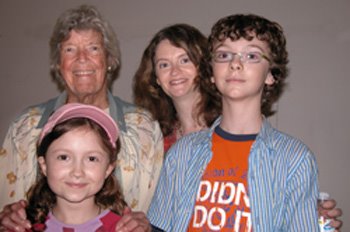
Today I sang my song "First Day of School" at the official opening of the June Callwood Way near my home. I took a risk in choosing that song--it wasn't specifically about activism, or social justice, or even community leadership--but on this late-August afternoon it somehow seemed right.
After the singing, Mayor David Miller said in his speech that Ms. Callwood had specifically asked that her new street be near children. As I watched my own children sitting patiently in the folding chairs, near the toddlers from the South-Riverdale Child Parent Centre nearby, I knew I had picked the right song.
Every day is a "first day" as I continue to make my way in music. I often feel excited as a child learning to walk...until I trip and fall and bruise my ego. I'm often feel as if I don't know what I'm doing...that I'm a neophyte, a newcomer, too "green".
Where will this lead? Will I succeed or fail? What do those words mean? Can I look the definition up somewhere?
On "first days" like today, I glimpse the answer, and try to write it down so I don't forget. It goes something like this.
I succeed when I give my music to people, instead of expecting to get somewhere with it.
I succeed when my song is a contribution to a greater good, not a good that is confused with a commodity.
I succeed when I am grateful for the gift of music, and when I share it freely and without expectation.
Those lessons, as right and clear as they seem today, seem at the same time completely at odds with the commercial entertainment industry and how "indie artists" are supposed to think of themselves: as products instead of service providers. We're encouraged to want to be "idols", we're not encouraged to serve.
Needless to say, I'm hardly immune to this skewed value-system myself. Like everyone in our culture, I'm dazzled and seduced by money and power. As a performer, I find myself wanting the kind of prestige that the celebrity class of artists enjoys--and sometimes walking in "ways" that are out of tune with my own deeper personal values. Running pell-mell toward professional achievement in music, I often overlook the other paths to fulfillment...ways that are, frankly, simpler and easier to manage. And which may reach more people in the long run.
What am I doing (the ambitious indie artist asks herself) playing yet another tiny community event for free, in a little tucked-away laneway, with my children in tow (people say I should hide my age and the fact that I have children if I want to "make it in the music business"). What am I doing? Am I crazy?
No, I'm not crazy. I'm playing The June Callwood Way. (Not "the Rogers Centre way".)
Today, June Callwood was simply bubbling over with pride to have that humble laneway named after her. The Way shined as brightly (and attracted as many luminaries) as any new four-lane expressway...and Ms. Callwood vowed to return frequently to help keep it well-maintained. Throughout her 82 year-old life, she has understood the worth and strength of each person and each small action. She knows that great things--such as the more than 50 community service organizations she's founded--start with humble first steps.
So there we were today, in a little lane, far away from the busy street. We were tucked away with the children, near the library, the community centre and the women's shelter. It felt right to offering my songs in that setting, among people who support others, as we gathered to honour a woman who is a radiant example of the power of service.
It was another first day, of many more to come, as we continue to make our way in the world.
Sunday, August 06, 2006
Garden Salad

Yesterday my sister-in-law came over to help me with my backyard garden.
Actually, "garden" may be too optimistic a word. It's the kind of space best described as "having a lot of potential". At the moment, it's mostly bare earth, patchy grass, and a few hopeful perennials I planted last week. My sister-in-law insisted that we remove all of the proliferating violets which had taken over most of the yard. I had been keeping them, not wanting to call them weeds, but Carina said they just looked like salad. Besides, she assured me, they'll come back anyway.
My now-barren back yard stands in stark contrast to my overly exuberant front yard. In that garden, the black-eyed susans have gone berserk, taking over the modest 15' x 15' space in an explosion of golden blooms (seen above). They're even taking over the neighbours' garden. (I must apologize when they come back from vacation.) And yet, I can't bring myself to pull out any of these overachieving flowers. They're excessive, yes...but they're healthy and strong and blooming and, well, beautiful. (I make a mental note to thin them in the fall.)
As I haltingly approach both yards--wondering what should stay and what should go, what I should water and what let die--I admire my friends who seem to be born gardeners. They achieve harmony and balance in their gardens: planting and watering faithfully, weeding decisively when necessary.
A few weeks ago, our daughter put a positive spin on a dandelion. Picking it up and blowing the seeds into the wind, she called it a "wishing weed". It's a touching irony that by making a wish on a dandelion, we scatter its seeds and virtually guarantee more pesky, proliferating, unwished-for growth. There's something about the dandelion's design that makes wishing on it come naturally. Its seeds are held more beautifully aloft than others'; yet, when they land, those seeds become "weeds" that are difficult to uproot and to ignore. It reminds me of that old saying, "Be careful what you wish for". Our hopes and dreams always carry the seeds of troublesome change.
In the removal of some plants and the encouragement of others, we create personal gardens that may, at the best of times, be balanced and harmonious...and at other times, may be pleasing (or at least amusing) in their un-balanced-ness.
I like mine on the wild side, and I'm inclined to be kind to weeds.
Subscribe to:
Comments (Atom)